


 9 minutos de lectura
 Última actualización: 28 Oct 2026
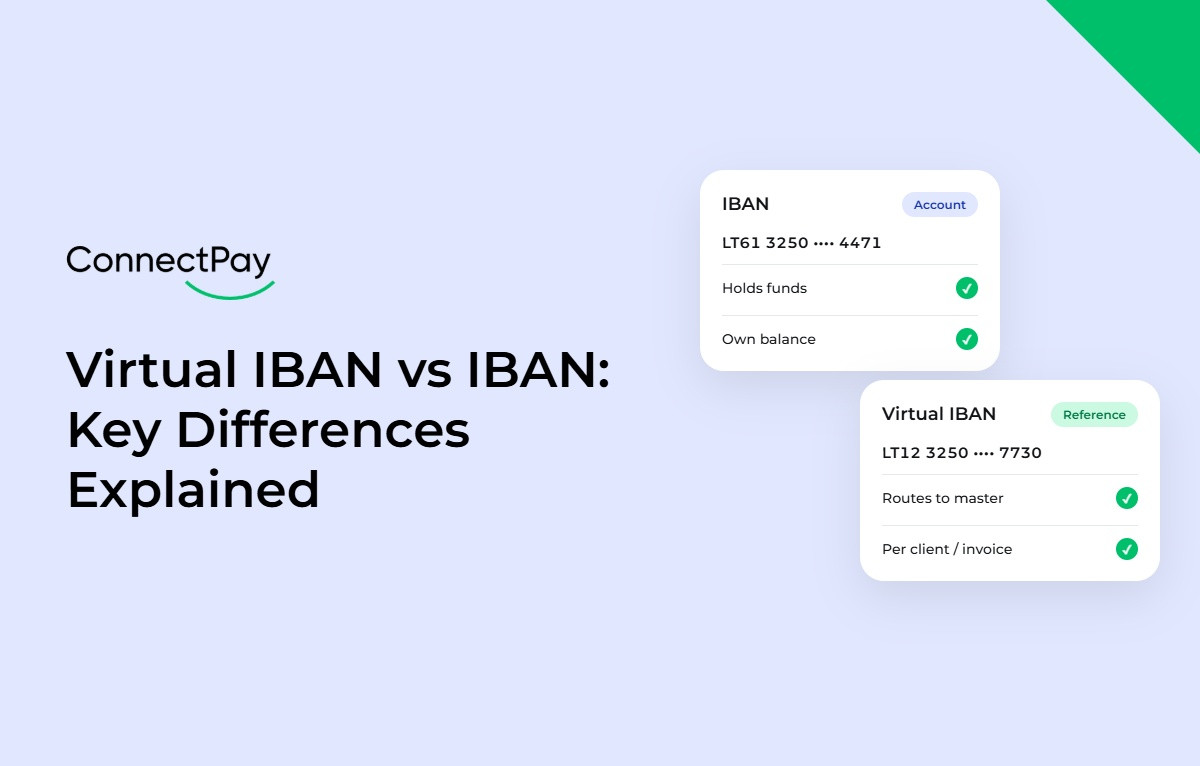


Virtual IBAN vs IBAN comes down to one question: does the number identify a real account, or does it point to one? A standard IBAN identifies an account that holds money in its own right. A virtual IBAN is an identifier that redirects incoming payments to another account, usually called the master account.
To a payer, the two look identical. Same format, same length, same country code at the start. The differences sit underneath: legal standing, whether there’s a balance, and who’s allowed to issue them.
We get asked about this a lot, often by businesses that want “a virtual IBAN” when what they actually need is an account. Below, we break down how each one works, what protects the money, where EU regulation is heading, and who each option is really for. If you only need an IBAN for your own business, start with our Cuentas con IBAN.
What Is an IBAN?
An IBAN (International Bank Account Number) is the standard format for identifying a single account at a specific institution. The ISO 13616 standard defines its structure, and every IBAN follows the same pattern. It starts with a two-letter country code, then two check digits, then a basic bank account number that includes the institution’s code and the account number itself.
Put together, a Lithuanian IBAN looks something like LT12 1000 0111 0100 1000. The check digits do more work than people expect. If you swap two numbers while typing an IBAN, validation usually fails before the payment ever leaves your bank.
Only licensed financial institutions can issue IBANs: banks, electronic money institutions (EMIs) and payment institutions. Keep that in mind when looking at IBAN vs virtual IBAN, because the same rule applies to both. IBANs are also what make euro payments across borders work. You need one for any Transferencia SEPA, whether you’re paying a supplier in Spain or getting paid by a client in Finland.
What Is a Virtual IBAN?
The EU Anti-Money Laundering Regulation gives the clearest definition we have. It describes a virtual IBAN as “an identifier causing payments to be redirected to a payment account identified by an IBAN different from that identifier.”
In practice, that means three things:
- A vIBAN has exactly the same format as a regular IBAN, so the payer’s bank treats it like any other.
- It routes every payment it receives to a master account, which is where the money actually sits.
- It holds no balance of its own. Look up the balance of a vIBAN and there’s nothing to see.
The useful part is the assignment. An institution can give each of its customers their own vIBAN. When a payment lands, the institution knows straight away who it belongs to, without matching references by hand.
What else a vIBAN can do depends on the provider. Supported payment rails, currencies and outgoing payments all vary. For a fuller walkthrough of how platforms and institutions put them to work, see our guide to virtual IBAN accounts.

¿Estás listo para actualizar tu infraestructura de pagos?
Deja de lidiar con flujos de pago fragmentados. Accede a IBAN específicos, SEPA Instant e integraciones API sin complicaciones, todo ello desde una única plataforma unificada.
Virtual IBAN vs IBAN: Key Differences
Here’s virtual IBAN vs IBAN side by side. Pay the most attention to the balance and protection rows, because that’s where the two diverge.
| Característica | Standard IBAN | Virtual IBAN |
|---|---|---|
| Qué es | Identifies a real account | An identifier that redirects payments to a master account |
| Balance | Holds funds in its own right | None, funds sit on the master account |
| Who issues it | Licensed financial institution | Licensed financial institution |
| Setup | Full onboarding of the account holder | Issued by an institution to its own customer under that institution’s KYC |
| Typical use | Holding operating funds | Giving each customer a dedicated number and tagging inflows |
| Reconciliación | By reference or statement | Each payment tied to its vIBAN |
| Protección | Depends on the holder’s licence and safeguarding | Not implied, depends on the master account |
The issuer row surprises people: both need a licensed institution behind them. The setup row is where they split. With a standard IBAN, the provider onboards you directly. A vIBAN is issued by an institution to its own customer under that institution’s KYC (know your customer) checks, so the infrastructure provider underneath never onboards the end customer.
Read the first and last rows together. An IBAN vs virtual IBAN comparison isn’t about which number is better. Two numbers that look the same on an invoice can carry very different legal and protective meaning. One is an account. The other is a label pointing at an account, and its safety depends entirely on whose account that is.
Is a Virtual IBAN Safe?
A vIBAN can be perfectly safe, but not because it’s a vIBAN. Having one doesn’t mean you have a separate account, and it doesn’t come with deposit protection. The money sits on the master account. What protects it is the licence of the institution holding that master account and how that institution safeguards client funds. For an EMI, safeguarding means keeping client money apart from its own, for example in cuentas separadas, so it stays protected if the institution fails.
Regulators haven’t always agreed on what a vIBAN even is. The European Banking Authority (EBA) found that national supervisors classify them inconsistently. Some treat a vIBAN as a simple identifier, others as a payment account in its own right.
On the payer side, there’s one reassuring check. Verification of Payee, mandatory for euro transfers in the euro area since October 2025, matches the payee’s name against the IBAN before the payment goes out. It applies to vIBANs just like any other IBAN.
If someone offers you a vIBAN, ask two questions:
- Which legal entity actually holds the funds?
- How are they safeguarded?
Virtual IBAN Regulation in the EU
Until recently, the EU had no common definition of a virtual IBAN. In May 2024, the EBA published its report on virtual IBANs (EBA/Rep/2024/08). It found no EU-level definition and inconsistent treatment across member states, which left gaps in how money laundering risks were handled.
The new EU Anti-Money Laundering Regulation (Regulation (EU) 2024/1624, or AMLR) closes the first gap. It defines a virtual IBAN and requires the institution issuing one to identify and verify the users of its vIBANs, plus the account each one is linked to. The AMLR applies from 10 July 2027.
Alongside it, the sixth AML Directive (Directive (EU) 2024/1640, or AMLD6) requires national bank account registers to include vIBANs. That lets authorities trace a payment from the virtual number to the real account.
Germany moved earlier. A BaFin order from December 2020 already requires institutions to record the end users behind vIBAN structures. In July 2026, BaFin warned about layered vIBAN structures, where the master account holder, an intermediary payment provider and the actual user are three separate parties.
The practical message is simple: you can’t outsource responsibility for knowing who ultimately uses a vIBAN. We cover the wider picture in our guide to cumplimiento de los pagos.
Who Can Issue and Who Can Get a Virtual IBAN?
Only licensed financial institutions can issue IBANs, and virtual ones are no exception. That leaves two models.
- In the first, a business gets IBAN details from a licensed provider. The business is the customer, and the provider onboards it directly. In the second, a licensed institution issues vIBANs to its own customers, with an infrastructure provider working in the background. Here the institution is the customer, and the end customers belong to the institution.
- Our vIBAN offering sits in the second model. Licensed EMIs, payment institutions and specialised banks can issue vIBANs through us, as long as they’re licensed in the EEA, the UK, the US or another jurisdiction we accept, and run their own AML/KYC programme. They issue the vIBANs to their own business customers.
If you’re a platform, marketplace, startup or regular business, a vIBAN programme isn’t what you need. You need an IBAN account: Business, Personal or Segregated, depending on how you handle funds. That’s not a downgrade. It’s the right tool for holding and moving your own money.
When to Use a Standard IBAN vs a Virtual IBAN
A standard IBAN is the right choice when you hold operating funds in your own name. Think of a logistics company paying drivers, collecting from clients and paying taxes. It needs one account, fully onboarded by its provider, with a real balance.
A virtual IBAN fits a different job. Picture a licensed payment institution with 4,000 business customers. Each customer needs a dedicated IBAN to share with their own clients, and the institution needs every incoming payment tagged to the right customer automatically. Issuing one vIBAN per customer does exactly that, with no manual matching of payment references.
In practice, most institutions use both. They hold one real master account where funds sit and are safeguarded, and they issue vIBANs on top of it to organise customer flows. The master account handles the money. The vIBANs handle the sorting.
How ConnectPay Fits In
Our vIBANs are LT-prefix IBANs that licensed institutions issue to their own business customers. Each one routes to the institution’s master account with us. Payments are sent and received in the end customer’s name, with Verification of Payee, and every incoming payment arrives tagged to the right customer with full payer details.
Institutions manage vIBANs through our API (open, block, unblock, close and list), with webhooks for updates. The institution handles KYC and ongoing monitoring of its customers. We provide the infrastructure and safeguard the funds. End customers are never onboarded to ConnectPay.
There are limits worth knowing up front. Our vIBANs support SEPA, SEPA Instant and internal transfers only. They have no balances of their own, and there’s no multi-currency, FX or SWIFT. They’re not available for individuals yet. If you’re weighing options, our roundup of proveedores de IBAN virtuales covers the wider market.
Know Which Number Holds the Money and Which One Only Points to It
The real question isn’t which type is better. It’s what each one does. A standard IBAN identifies an account that holds funds. A virtual IBAN redirects and identifies payments, while the money sits somewhere else. Once you know which is which, the questions about protection, regulation and fit mostly answer themselves.
That distinction is about to carry more weight. When the AMLR applies from July 2027, every institution issuing vIBANs will need to know who stands behind each one and which account it links to. Supervisors like BaFin are already moving in that direction.
If you’re a licensed institution looking at a vIBAN programme, or a business working out which account you actually need, talk to our team.


