6 Lesezeit


We’ve just launched virtual accounts, which let licensed financial institutions give each of their business customers an IBAN in the customer’s own name, without building payment infrastructure or connecting to SEPA themselves. Monika Satkauskė, Product Manager at ConnectPay, led the product from the first conversations with institutions to launch. We asked her what vIBANs are, how Verification of Payee changed the picture, and what an institution should have ready before getting started.
Die wichtigsten Erkenntnisse
-
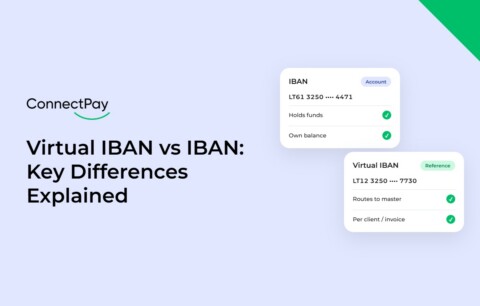
 A virtual IBAN routes payments into one master account and holds no balance of its own.
-
Institutions can give business customers IBANs in their own names, without their own SEPA connection or EEA presence.
-
Payments are matched to customers automatically, with no manual reconciliation.
-
Under Verification of Payee, payers see the customer’s own name as a match.
-
The product took four to five months from idea to launch, with six teams involved.
How would you explain a virtual IBAN to someone outside payments?
I’ll give this analogy that explains vIBANs quite well. Picture an apartment building. It has one street address, and every flat inside has its own number, so a letter addressed to flat 12 always reaches the right person, even though everything is delivered to the same building.
A virtual IBAN works the same way. The master account is the building: the one place where all the money actually arrives and is kept. Each virtual IBAN is a flat number, a unique address that belongs to a business customer. When someone makes a payment to a vIBAN, the money is credited to the master account, with the business customer shown as the beneficiary.
What were financial institutions asking for that made you build this?
It kept coming up in our conversations with different financial institutions. One financial institution with hundreds of customers told us that their customers need SEPA-connected accounts in the customers’ names. This institution simply couldn’t offer such accounts: no SEPA connection, no EEA presence. Others were stuck with one shared account, and their team spent hours every week working out who had paid what.
When several institutions asked for the same thing, and Verification of Payee made shared accounts even harder to live with, it became clear we had to extend our product offering and serve such institutions. They didn’t want the huge cost of building the infrastructure themselves or joining the SEPA schemes. They just wanted their customers to have an account in their own name and to send and receive payments.
How long did it take from first idea to launch, and what did that journey look like?
About four to five months from first idea to launch. We started with discovery: talking to institutions and agreeing internally on exactly what a vIBAN should and shouldn’t do, what features the product must have, what the risks are and how we’d mitigate them. Then came compliance design, which meant deciding how responsibilities are split between us and the institution and how we oversee activity on every vIBAN. Our Product & Technology team then built it on our existing payments infrastructure, so vIBANs use the same SEPA connection our customers already rely on. Around six teams were involved in this process.
What was the hardest part to get right?
Identifying the risks that come with a new product like this, and putting effective controls in place to mitigate them. With vIBANs, payments move in the names of end users who aren’t ConnectPay’s own customers, so we had to understand those risks fully and keep them under control from day one. Once that foundation was in place, implementation followed. We had to fit vIBANs into our existing payments infrastructure, alongside our regular corporate accounts, and into our core system, without disrupting the accounts our customers already rely on.
What breaks when an institution runs all its customers through one shared account?
Matching payments to customers, in other words reconciliation, is the heaviest part. With one shared account, every incoming payment lands in the same place, and the only clue to who it’s for is the payment reference. Senders forget it, mistype it or paste an old invoice number. Then someone in operations has to investigate, check names, contact the client and wait. That means money sitting in limbo, hours of manual payment reconciliation every day, and support tickets from customers asking “where’s my money?” With vIBANs, the IBAN itself tells you who the money is for, so payments are matched automatically.
How did Verification of Payee change the picture?
Since October 2025, banks in the eurozone check the payee’s name before a SEPA or SEPA Instant payment goes out. You enter the IBAN and the name, and your bank tells you whether it’s a match, a close match or no match. That’s great for stopping fraud, but tough for pooled accounts. Imagine paying “Baltic Tiles” into a shared account that’s registered in the payment institution’s name. The payer sees a name mismatch warning, and many will stop or call to ask if something’s wrong. With a vIBAN, the VoP check comes back with the end user’s own name, so the payer sees a match and pays with confidence.
What’s the biggest misconception about virtual IBANs?
Probably that a vIBAN is just like any other payment account. It isn’t. A vIBAN looks like an IBAN, but it really acts as a payment routing mechanism: an address that holds no money and has no balance. When a customer pays Baltic Tiles’ vIBAN, the funds land in the institution’s master account, credited to Baltic Tiles. When Baltic Tiles pays someone, the money is debited from the master account and sent in Baltic Tiles’ name.
Who is responsible for what between ConnectPay and the partner institution?
It works like a correspondent–respondent relationship, with ConnectPay as the correspondent and the partner institution as the respondent.
- The institution knows its customers. It onboards its customers, runs KYC and ongoing AML checks on them, decides who gets a vIBAN and keeps each customer’s balance in its own systems.
- ConnectPay knows the institution. We do due diligence on the institution, provide the master account, the vIBANs and the SEPA connection, route every payment to the right vIBAN and oversee activity across the vIBANs.
In practice, when a payment for End user 3 arrives, we credit the master account and pass on the vIBAN details, and the institution updates End user 3’s balance.
What should an institution have ready before it talks to you?
A few things make the first conversation much faster:
- a payment or e-money licence, or an equivalent licence
- an AML and KYC programme for your own customers, with controls in place
- a clear use case: who your customers are and what problems you’re solving with vIBANs
- rough volumes, meaning how many vIBANs you’d open and how many payments a month you expect
- a tech team or integration partner ready to integrate ConnectPay APIs
What’s next for the product?
We’re starting with business customers, because that’s where we heard the strongest demand. The natural next direction is vIBANs for individual customers too, so institutions can offer the same experience to consumers. Beyond that, we’ll keep listening to our partners about where vIBANs can help them grow. If you have a use case in mind, we’d love to hear it, and we’d like to work on it with you.
Find out more about ConnectPay virtual accounts hier.