













 15 min read


When we evaluate the modern digital economy, we see that fintech API companies completely drive the engine of innovation. An Application Programming Interface (API) allows two software systems to communicate. In finance, fintech APIs allow a software company (like a SaaS platform or a gig-economy marketplace) to plug complex financial services directly into their own product. This is the foundation of embedded finance. Instead of spending three years and millions of dollars acquiring a banking license and building proprietary payment gateways, developers use the best fintech API companies to launch financial products in weeks.
We see teams use these APIs to issue physical debit cards, open user bank accounts, execute massive bulk payouts, and process international credit cards seamlessly. Finding the right partner is critical because you are essentially outsourcing your core financial infrastructure. In this guide, we will compare the top market leaders. Whether you need a simple payment gateway or you require a deeply integrated, EMI-licensed platform like ConnectPay to build a full neobank experience, we will help you identify the exact API infrastructure your developers need to scale.
Quick Answer: What Are the Best Fintech API Companies?
If you need a fast recommendation for the best fintech API provider, here is our quick breakdown of the top platforms. The best choice depends entirely on whether you need simple payments, data aggregation, or full banking infrastructure.
- ConnectPay: The top choice for European platforms needing full-stack embedded finance and banking APIs.
- Stripe: The go-to developer platform for highly customized payment checkout flows.
- Plaid: The absolute leader for aggregating user bank account data securely.
- Adyen: The premium choice for massive global enterprise payment routing.
- Checkout.com: The API-first payment engine for rapidly scaling international brands.
- Marqeta: The dominant platform for issuing highly customized physical and virtual cards.
- Solaris: A powerful licensed BaaS provider for the European market.
- Airwallex: The best global financial infrastructure API for managing international treasury.
- Treasury Prime: The top BaaS connector for US-based fintechs working with partner banks.
Identifying the top fintech API companies requires aligning their specific API endpoints with your product roadmap.
Comparison of Fintech API Companies
To help you make an informed decision on the right fintech API provider fast, we created this comparison table summarizing the top names. Comparing these platforms side-by-side helps you identify the core features that will actually drive your revenue forward.
| Provider | API Type | Core Features | Best For | Key Advantage |
|---|---|---|---|---|
| ConnectPay | BaaS & Payments | IBANs, SEPA/SWIFT, Wallets, Compliance | European platforms | Full-stack embedded finance |
| Stripe | Payments | Checkout, Subscriptions, Payouts | Tech-savvy startups | Unmatched developer APIs |
| Plaid | Data | Account linking, balance checks | Apps needing bank data | Ubiquitous US bank coverage |
| Adyen | Payments | Global acquiring, Omnichannel | Global enterprises | Unified enterprise platform |
| Checkout.com | Payments | Payment processing, routing | Scaling ecommerce | Granular data control |
| Marqeta | Card Issuing | Virtual/physical cards, spend limits | Card programs | Highly flexible card controls |
| Solaris | BaaS | Accounts, lending, cards | European fintechs | Full banking license |
| Airwallex | Infrastructure | Global accounts, FX, payouts | Global SaaS | Powerful cross-border APIs |
| Treasury Prime | BaaS | Account creation, ACH, wires | US-based fintechs | Strong US bank network |
A strong fintech API platform provides the exact endpoints your specific product demands, whether that is data access or money movement.
9 Best Fintech API Companies
Let’s dive deeper into this curated list of the 9 top fintech API companies dominating the market today. These solutions represent the best fintech API companies available right now. We evaluate each fintech API provider based on real-world execution, API documentation quality, and scalability. If you want to build top-tier financial products, start here.
1. ConnectPay
Best for: European platforms needing full embedded finance APIs

We built ConnectPay as a fully EMI-licensed fintech API platform specifically designed for digital-first businesses. While basic payment gateways just authorize a credit card, our platform acts as the complete financial backbone for your growing digital business. We see developers use our system to confidently manage complex, cross-border revenue streams.
ConnectPay fintech API platform features include robust endpoints for seamless SEPA and SWIFT transfers, dedicated multi-currency IBAN creation, and integrated digital wallets. Furthermore, we provide a complete banking as a service (BaaS) layer. We handle the massive regulatory burden of GDPR and PSD2 compliance on your behalf. Our APIs execute strict KYC/AML checks instantly. For example, a European freelance marketplace uses ConnectPay APIs to automatically generate a unique IBAN for every new freelancer, accept payments in euros, and distribute payouts securely, all within one seamless product experience.
Pros:
- Full-Stack Infrastructure: We provide complete embedded finance capabilities via API, not just single-purpose payment links.
- Built-in Compliance: We reduce your operational burden by managing strict European financial regulations automatically.
- Scalable Architecture: Our modular APIs allow you to launch wallets today and add white-label cards tomorrow.
Cons:
- European Focus: Our core compliance infrastructure is heavily optimized for European-based entities.
- Advanced Features: Our robust platform serves scaling businesses; it might feel too advanced for a weekend hobby site needing a simple checkout button.
For digital platforms, we are one of the leading fintech API companies. If you need reliable, full-stack embedded finance combined with strict European compliance, ConnectPay is the ultimate choice.
2. Stripe
Best for: Developer-friendly payment APIs

Stripe dominates as the developer-first standard for modern online commerce. We see technical startup founders use Stripe to build customized checkout flows. You can mold their APIs to fit any unique software-as-a-service (SaaS) or ecommerce model imaginable.
Stripe provides customizable checkout pages, subscription billing engines, and connected account logic for split payments. For instance, a small software startup uses Stripe to manage monthly subscriptions and handle failed payment retries automatically via API.
Pros:
- Unmatched Flexibility: Build any digital payment experience using their pristine API documentation.
- Massive Integrations: Connect natively to thousands of CRMs and accounting tools.
Cons:
- Limited Beyond Payments: They do not offer full banking core replacements or dedicated IBAN generation.
- Pricing Transparency: Flat-rate pricing becomes expensive as you process higher volumes.
Stripe remains a dominant fintech API provider for teams prioritizing checkout customization.
3. Plaid
Best for: Financial data and account connectivity APIs

Plaid completely revolutionized how apps access financial data. We see almost every major personal finance app use Plaid to connect securely to users’ bank accounts. They do not process payments; they provide the data infrastructure.
Plaid’s APIs allow a developer to instantly verify an account balance before triggering a transfer, or to pull months of transaction history to build a budgeting app.
Pros:
- Ubiquitous Coverage: They connect to thousands of banks across North America and Europe.
- Strong Data Parsing: They clean up messy bank data into standardized, readable JSON formats.
Cons:
- Not a Payment Processor: You must pair Plaid with a payment API (like Stripe) to actually move money.
- Data Reliability: Sometimes bank connections break if the underlying bank updates its portal.
Plaid offers the most essential fintech APIs for developers building data-heavy financial apps.
4. Adyen
Best for: Enterprise payment and API infrastructure
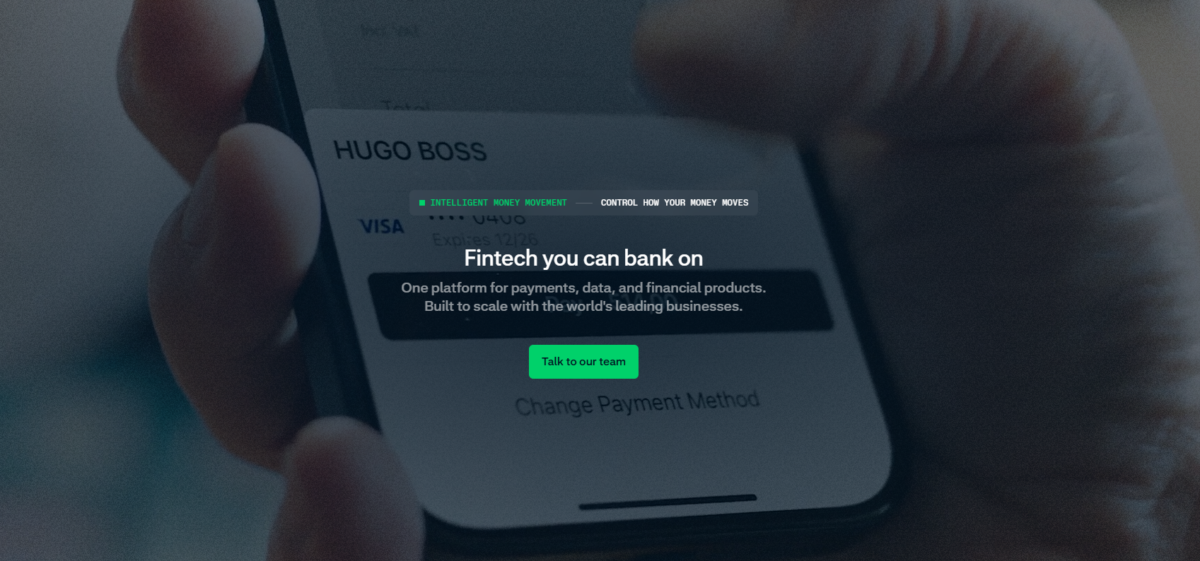
Adyen serves as a premium, unified commerce engine. We see highly successful, massive enterprises use Adyen’s APIs when they need to consolidate fragmented international payment systems into one clean, global data stream.
Adyen provides direct global acquiring, meaning their APIs connect directly to Visa and Mastercard networks to improve authorization rates globally.
Pros:
- Massive Scalability: They handle massive transaction volumes efficiently across nearly every continent.
- Global Reach: They process local payment methods in dozens of countries natively via API.
Cons:
- Extreme Complexity: Adyen requires extensive technical resources to integrate.
- Accessibility: They enforce high monthly volume minimums, making them inaccessible for new businesses.
Adyen ranks clearly among the top fintech API companies for massive global enterprises.
5. Checkout.com
Best for: Flexible payment APIs for scaling businesses

Checkout.com is an API-first payment platform built for ecommerce businesses growing rapidly and requiring deep global reach. As one of the best fintech API companies, they give mid-to-large brands the API tools to expand into new markets with granular data control.
They offer a unified global payment API, smart routing logic to increase approval rates, and detailed webhooks.
Pros:
- Performance Tracking: Analytics help you understand exactly why a payment failed via API response codes.
- Flexible APIs: Their tech stack is modern, modular, and built strictly for developers.
Cons:
- Tech Requirements: You absolutely need an engineering team to get the most out of their features.
- Target Market: They focus on larger, high-growth brands rather than simple plug-and-play shops.
6. Marqeta
Best for: Card issuing and payment APIs

Marqeta dominates the specific niche of card issuing. If you want to launch a physical or virtual debit card with your company’s logo on it, you likely use Marqeta’s APIs. We see gig-economy platforms use Marqeta to issue instant virtual cards to drivers so they can pay for gas.
Their “Just-in-Time” (JIT) funding API allows your platform to approve or decline a card swipe in real-time based on custom logic.
Pros:
- Granular Control: You control exactly where, when, and how much a card can spend via API.
- Modern Architecture: Built entirely for developers wanting to launch innovative card programs.
Cons:
- Narrow Focus: They only do card issuing; you need other partners for broader BaaS needs.
- Partner Requirements: You still need a sponsor bank to hold the actual funds.
Marqeta is a highly specialized fintech API platform for innovative card products.
7. Solaris
Best for: Banking-as-a-Service APIs in Europe

Solaris operates as a powerful BaaS provider in Europe. Because they hold a full banking license, their APIs allow other companies to offer true bank accounts and lending products without needing a license themselves.
We see European startups use Solaris APIs to launch full-fledged neobanks from scratch in a matter of months.
Pros:
- Full Banking License: They provide regulatory cover for the products you build on their APIs.
- Comprehensive Suite: Offer accounts, cards, and consumer lending via a single API integration.
Cons:
- Complex Onboarding: The legal and technical onboarding process is notoriously heavy.
- Europe Focused: Their services and licenses are restricted to the European market.
Solaris is a heavyweight fintech API provider for companies building complex financial products in the EU.
8. Airwallex
Best for: Global financial infrastructure APIs
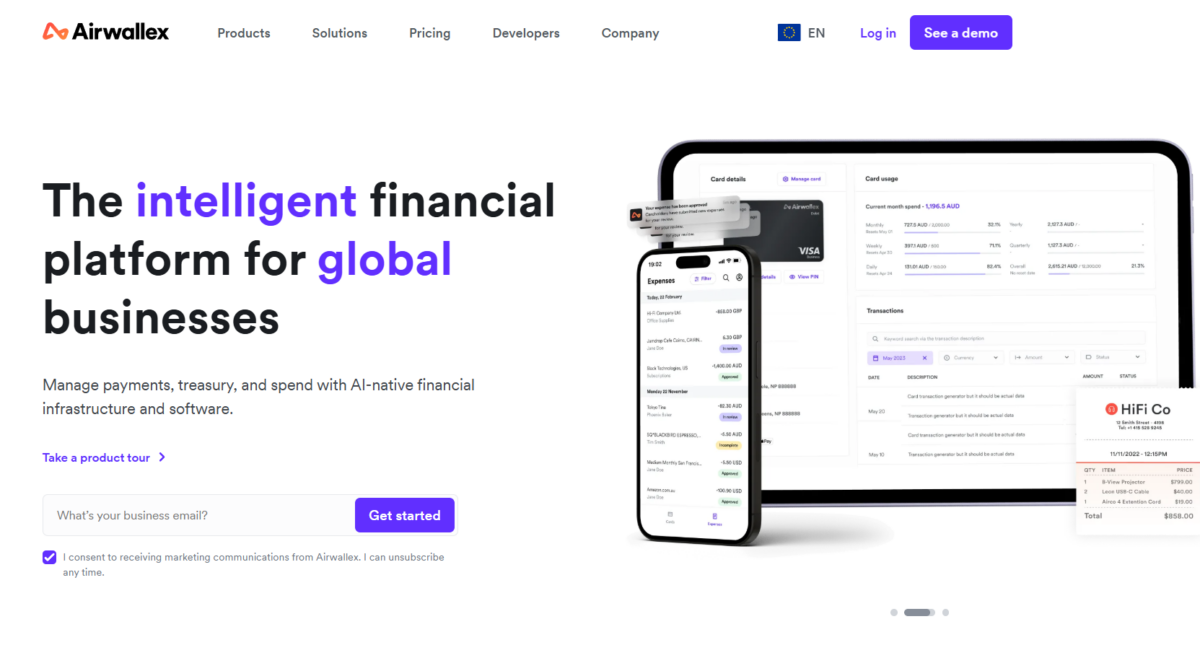
Airwallex operates as a massive financial infrastructure platform. Large global businesses and SaaS platforms use Airwallex APIs to programmatically manage highly complex international cash flows and treasury operations.
They offer powerful multi-currency accounts, highly capable APIs for automated global payouts, and foreign exchange (FX) management endpoints.
Pros:
- Strong APIs: Their technical documentation allows for deep, programmatic financial control globally.
- Global Reach: They offer excellent global acquiring and payout networks with multiple currencies.
Cons:
- Complex Setup: The API integration process requires significant technical effort.
- Pricing Complexity: Managing multiple international API endpoints can make pricing unpredictable.
Airwallex is consistently ranked as the best fintech API provider for massive tech startups scaling globally.
9. Treasury Prime
Best for: US-based Banking-as-a-Service APIs

Treasury Prime focuses intensely on connecting fintech developers directly to a network of US sponsor banks. We see US startups use Treasury Prime APIs to launch commercial banking products or specialized lending apps.
They provide clean API endpoints for opening FDIC-insured accounts, executing ACH transfers, and managing wire payments.
Pros:
- Strong Bank Network: They offer direct connections to multiple forward-thinking US banks.
- Flexible APIs: Their endpoints are clean, modern, and developer-friendly.
Cons:
- US Focused: Their infrastructure is entirely tied to the United States banking system.
- Bank Partner Dependence: You are still subject to the compliance approval of the underlying sponsor bank.
Treasury Prime is an essential entry on the list of fintech API companies for the US market.
Full-Stack Fintech APIs vs Single-Purpose APIs
You must understand the distinct operational differences between these two API models. Single-purpose APIs do one thing incredibly well. Plaid only does data connection. Stripe (historically) only processed incoming payments. If you use single-purpose APIs, your engineering team must stitch together multiple different providers to build a complete product.
Conversely, full-stack fintech API companies provide the entire infrastructure under one roof. When you use best embedded finance providers like ConnectPay, you get API endpoints for incoming payments, dedicated account generation, compliance checks, and outgoing bulk payouts. This massively reduces engineering overhead. If you are building complex marketplace payment solutions, a full-stack API prevents your team from managing five different vendor relationships and wrestling with conflicting API data structures.
How to Choose the Right Fintech API Provider
Finding the right fintech api provider requires a highly strategic approach. You must evaluate how your specific software model operates daily. A consumer budgeting app needs entirely different API endpoints than a cross-border SaaS software company. We use this actionable framework to help founders select the optimal platform among the top fintech API companies.
API Coverage and Modularity
First, evaluate exactly what endpoints you need today versus what you will need in three years. Do you just need to authorize a credit card, or will you eventually need to issue segregated accounts to your users? The best fintech APIs are highly modular, allowing you to turn on new financial features natively without ripping out your core infrastructure and starting from scratch.
Developer Experience and Integration Speed
Evaluate the API documentation directly. If a system requires a computer science degree just to authenticate a test call, it will slow down your entire team. A top-tier fintech API platform provides clean SDKs, clear error codes, and a robust sandbox environment for testing. Furthermore, ensure they offer pre-built endpoints for complex European regulations, such as strong customer authentication (SCA), to save your engineers months of compliance coding.
Compliance, Licensing, and Security
You absolutely cannot ignore regulatory security. Fintech platforms act as prime targets for global fraudsters. Your API provider must handle strict compliance completely on your behalf. The best-rated fintech API companies operate with actual EMI or Banking licenses. They must offer endpoints for active fraud protection, biometric authentication, and data tokenization. Finding a partner that offers embedded compliance and strong API security and fraud prevention protects your growing brand from devastating financial fines.
Scalability and Infrastructure
Do not just pick an API for your MVP launch; pick one built for massive scale. As you grow, you will likely need to issue massive bulk payouts or manage complex lending platforms logic. The top fintech API companies offer infrastructure that handles millions of API calls per hour without latency spikes, ensuring your application remains fast and responsive regardless of your user load.
Ready to Build with Fintech APIs?
As your software platform scales, relying on basic, fragmented payment tools is a liability. To successfully capture global markets and build highly sticky, innovative product features, you must adopt scalable, modern API solutions. The best fintech API companies do much more than just authorize a basic credit card; they offer full, embedded financial infrastructure to support your entire digital roadmap.
We built ConnectPay specifically as a future-ready, compliant API option for growing online businesses and digital platforms. From handling complex multi-currency accounts via API to offering deep compliance and global reach, we give your engineering team the backend power to scale without limits. Stop losing engineering months to legacy banking integrations. Visit our platform to explore the ultimate business account and discuss how our APIs can implement powerful financial tools to streamline your operations and safeguard your global revenue.
FAQs: Fintech API Companies
What are fintech API companies?
They are infrastructure providers that offer Application Programming Interfaces (APIs) allowing software developers to easily embed complex financial services – like payments, bank accounts, card issuing, or data aggregation – directly into their own apps or platforms.
Which is the best fintech API provider?
It depends entirely on your product needs. ConnectPay is the top choice for European platforms needing full-stack embedded finance and compliance APIs. Stripe dominates for highly technical developers needing custom payment checkout flows. Plaid is best for data aggregation.
What can fintech APIs be used for?
Developers use them to accept credit card payments, issue branded debit cards, create multi-currency digital wallets for users, execute massive bulk payouts, and verify user bank account balances in real-time.
How do fintech APIs handle compliance?
Top-tier API providers (especially those with EMI or Banking licenses) build compliance directly into their endpoints. They automate the required KYC/AML identity checks, enforce transaction monitoring, and ensure data handling meets strict regulations like GDPR and PSD2.
Are fintech APIs secure?
Yes. Modern fintech APIs utilize robust security protocols, including OAuth 2.0 authentication, heavy TLS data encryption, and network tokenization to ensure sensitive financial data is transmitted and stored securely.
Why choose ConnectPay for fintech APIs?
For European digital platforms expanding globally, ConnectPay provides unmatched, full-stack multi-currency infrastructure. We offer clean APIs for payments and Banking-as-a-Service, combined with built-in regulatory compliance, drastically reducing the engineering and legal burden on your team.


