











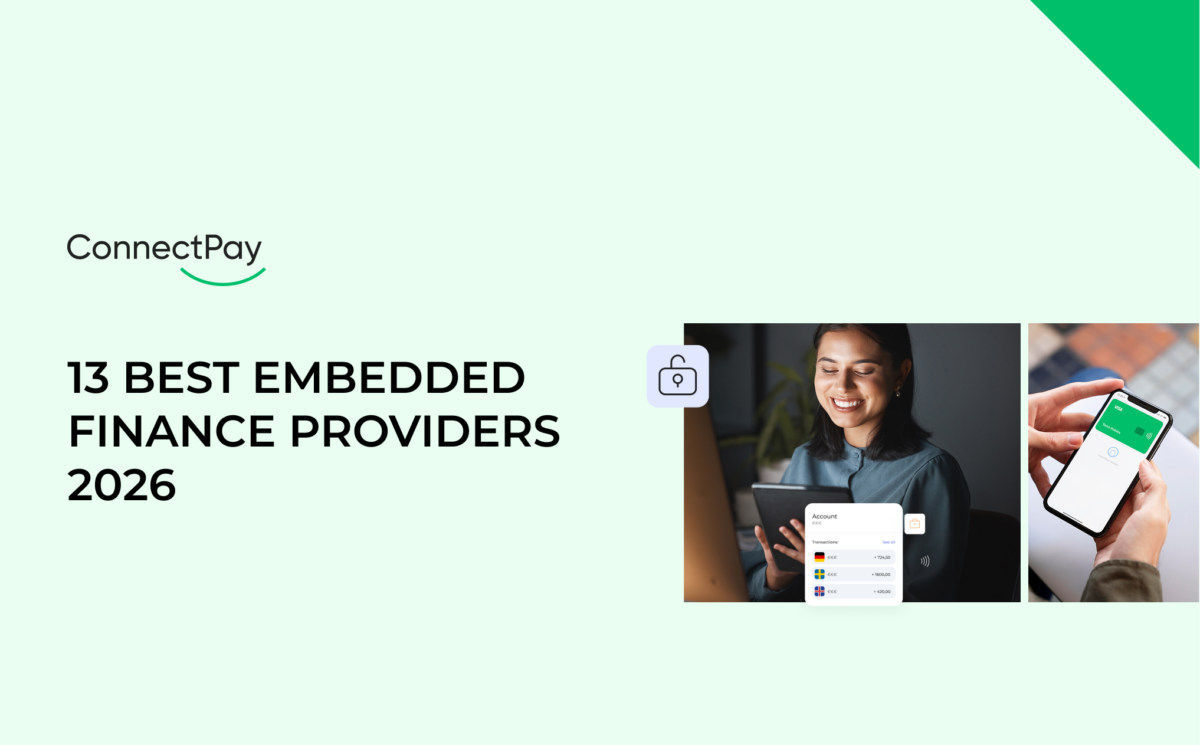
The best embedded finance providers are helping digital platforms turn financial services into a natural extension of their products. For SaaS companies, marketplaces, fintech startups, and enterprise product teams, embedded finance has become a powerful way to deepen customer relationships, unlock new revenue streams, and expand product ecosystems without becoming a bank themselves.
This guide compares 13 leading embedded finance companies and platforms that enable businesses to integrate financial products without building banking infrastructure from scratch. From embedded banking and card issuing to payments, lending, and compliance infrastructure, these providers supply the APIs and regulatory frameworks that make financial features possible inside non-financial products.
Instead of navigating payment networks, regulatory obligations, and risk management alone, companies can rely on specialized platforms designed to support scalable embedded financial services. The right provider can dramatically reduce time to market while ensuring the underlying financial infrastructure remains secure and compliant.
Whether you’re launching financial features for the first time or expanding an existing fintech roadmap, choosing the right embedded finance partner is a critical step toward building sustainable, revenue-generating financial products.
Best embedded finance providers: quick overview
- Best overall embedded finance platform – ConnectPay. Regulated EU infrastructure for embedded banking, payments, and scalable financial products.
- Best US startup-friendly platform – Unit. Fast-launch embedded finance APIs for startups building financial features.
- Best enterprise-grade solution – Solaris. Fully licensed European embedded banking provider.
- Best embedded payments company – Adyen for Platforms. Global acquiring and payments infrastructure.
- Best for marketplaces – Payoneer. Strong global payout capabilities.
- Best for global scale – Airwallex. Multi-currency payments, FX, and international financial infrastructure.
13 best embedded finance providers
1. ConnectPay
Best for European SaaS platforms and fintechs needing regulated embedded banking and payment infrastructure.
ConnectPay stands out among embedded finance providers by focusing on one critical advantage many platforms underestimate: regulatory infrastructure. Rather than simply offering payment APIs, ConnectPay delivers a compliance-first environment that enables SaaS platforms, marketplaces, and fintech startups to launch embedded financial services within a fully regulated European framework.
As a licensed Electronic Money Institution (EMI) in the European Union, ConnectPay provides the regulatory foundation companies need to build scalable embedded finance solutions. Businesses can offer dedicated IBAN accounts, process payments, and integrate financial capabilities directly into their platforms without navigating the complexities of licensing, AML obligations, or payment scheme participation themselves.
The platform supports SEPA and SWIFT connectivity, allowing companies to operate across European and international payment rails while maintaining operational control and transparency. Through API-driven integration, product teams can embed financial capabilities such as account infrastructure, payment processing, and card issuing directly into their applications.
A key differentiator is ConnectPay’s built-in compliance and AML infrastructure, which helps platforms manage regulatory responsibilities while scaling financial products across the EU market. For SaaS companies, marketplaces, and fintech innovators expanding in Europe, this regulatory backbone can significantly reduce operational friction and accelerate product launches.
In short, ConnectPay combines embedded banking infrastructure, payment capabilities, and regulatory expertise, making it a strong choice for European SaaS platforms, marketplaces, and fintech startups building compliant, scalable financial products.

2. Stripe Treasury
Best for US-based platforms embedding financial accounts within the Stripe ecosystem.
Stripe Treasury is one of the most recognizable embedded finance platforms, particularly for startups and technology companies already building within the broader Stripe ecosystem. It enables platforms to embed financial accounts directly into their products, allowing users to hold funds, send payments, and manage balances without leaving the application.
Rather than operating as a bank itself, Stripe Treasury is built on partnerships with US chartered banks, which provide the underlying financial accounts and regulatory coverage. Through Stripe’s APIs, companies can offer users financial accounts, ACH transfers, and card capabilities, all integrated within their existing platform experience.
One of Stripe Treasury’s biggest strengths is its developer-first infrastructure. Stripe has long been known for well-documented APIs, clear SDKs, and a strong developer community, making it easier for product teams to launch financial features without navigating complex banking integrations. For early-stage startups and scaling tech platforms, this ecosystem can significantly reduce development time. Stripe Treasury also integrates seamlessly with other Stripe products, including payments, billing, and card issuing. This allows companies to build complete financial experiences inside a single infrastructure stack.
For US-based SaaS platforms and fintech startups looking to embed financial accounts quickly while leveraging a familiar developer environment, Stripe Treasury remains one of the most accessible and widely adopted solutions.
3. Solaris
Best for fully licensed embedded banking in Europe.
Solaris is one of the most established providers of embedded banking infrastructure in Europe, offering a fully regulated banking platform for companies that want to integrate financial services directly into their products. Unlike many providers that rely on partner banks, Solaris operates with a German banking license, allowing it to deliver regulated banking services through its own infrastructure.
This licensing model enables Solaris to provide a broad range of financial capabilities, including digital accounts, payment processing, card issuing, and lending. Companies can integrate these services into their platforms using modular APIs, selecting only the financial features they need while maintaining flexibility as their product evolves.
Solaris has positioned itself as a full-stack embedded banking provider, meaning it combines technology infrastructure with regulatory coverage and compliance management. Its platform includes built-in support for onboarding, KYC processes, and risk management, helping companies launch financial products while meeting strict European regulatory requirements. Because of its regulatory depth and infrastructure scope, Solaris is often used by larger fintechs, digital banks, and enterprise platforms that require a reliable partner capable of supporting complex financial products.
For companies building financial services in Europe, Solaris offers a strong combination of licensed banking infrastructure, modular APIs, and enterprise-level compliance, making it a well-established player in the embedded finance ecosystem.
4. Unit
Best for US startups building embedded financial services.
Unit is a popular choice for startups looking to launch embedded finance services without building complex banking infrastructure from scratch. The platform focuses on helping technology companies add financial features, such as accounts, cards, and payments, directly into their products through simple integrations.
Instead of operating as a bank, Unit works with FDIC-insured bank partners in the United States. These partnerships provide the regulated foundation that allows startups to offer financial accounts, payment capabilities, and card programs while ensuring deposits are protected and compliance requirements are met.
A major advantage of Unit is its developer-friendly API infrastructure. The platform offers clear documentation, prebuilt components, and flexible integrations that make it easier for product teams to embed financial functionality into existing applications. For startups with small engineering teams, this developer-first approach can significantly reduce implementation complexity.
Unit is also known for its fast launch timelines. Many startups use the platform to bring financial products to market relatively quickly compared with traditional banking integrations. Companies can launch features like digital accounts, payment tools, and card programs while focusing on their core user experience. For US tech startups entering embedded finance, Unit offers a streamlined path to building and scaling financial features.
5. Treasury Prime
Best for direct US bank integrations via API.
Treasury Prime is an infrastructure-focused provider that connects fintech companies and software platforms directly with regulated US banks. Rather than offering packaged financial products, the company provides the technology layer that allows businesses to integrate banking capabilities through a flexible API-first model.
At the core of Treasury Prime’s platform is its bank partner network, which links fintech startups, SaaS platforms, and marketplaces with chartered US banks. This structure allows companies to launch financial services such as accounts, payments, and card programs while operating within an established regulatory framework.
A key part of the platform is its suite of compliance tools. Treasury Prime helps businesses handle critical regulatory processes like customer onboarding, identity verification, and transaction monitoring. These capabilities allow companies to embed financial features while still meeting banking and compliance requirements. The platform is particularly appealing for companies that want more direct control over their banking integrations rather than relying entirely on pre-built fintech solutions. By acting as the technical bridge between banks and software platforms, Treasury Prime simplifies complex banking integrations.
For US fintechs and technology companies building financial products, Treasury Prime provides a flexible infrastructure layer designed to support scalable embedded finance services.
6. Adyen for Platforms
Best for large marketplaces embedding global payments.
Adyen for Platforms is one of the most established solutions among embedded payments companies, designed specifically for marketplaces, platforms, and large digital ecosystems that need to manage payments at scale. Built on Adyen’s global payments infrastructure, the platform allows businesses to embed payment capabilities directly into their products while maintaining centralized control over transactions and financial flows.
A major strength of Adyen is its global acquiring network, which enables platforms to accept payments across numerous regions, currencies, and payment methods through a single infrastructure. This makes it particularly valuable for companies operating internationally or planning to expand into multiple markets. Adyen for Platforms also provides a range of platform-focused tools designed to support complex marketplace models. These include merchant onboarding, automated payout management, split payments, and financial reporting. Platforms can manage sellers, service providers, or partners within their ecosystem while ensuring payments are processed securely and efficiently.
The solution is typically geared toward enterprise-level platforms, which means implementation often involves structured onboarding and long-term enterprise contracts. Companies such as large marketplaces, mobility platforms, and digital service ecosystems commonly use Adyen to manage large volumes of transactions.
For enterprises building global marketplaces or platform economies, Adyen for Platforms offers a strong payment infrastructure designed for scale, compliance, and international reach.
7. Marqeta
Best for embedded card issuing and modern fintech programs.
Marqeta is widely recognized as a leader in modern card issuing infrastructure, helping fintech companies and digital platforms launch flexible card programs through API-driven technology. The company focuses primarily on enabling businesses to create, manage, and scale card-based financial products without building their own issuing infrastructure.
At the center of Marqeta’s platform are its modern card issuing APIs, which allow companies to issue physical and virtual cards, control transaction rules, and build highly customized payment experiences. Developers can configure spending controls, tokenization, and real-time authorization features, making the platform particularly attractive for companies designing specialized payment products.
Marqeta’s technology is used by several well-known fintech leaders, including digital banks, buy-now-pay-later providers, and on-demand service platforms. These companies rely on Marqeta’s infrastructure to power card programs that support everything from consumer payments to expense management and marketplace payouts.
While the platform has expanded internationally in recent years, Marqeta remains primarily focused on the US market, where it partners with issuing banks and payment networks to deliver regulated card programs. For fintech companies and digital platforms building card-based financial products, Marqeta offers a developer-friendly infrastructure designed specifically for scalable embedded card issuing.
8. Banking Circle
Best for PSPs and financial institutions embedding cross-border capabilities.
Banking Circle is often listed among the top embedded finance providers for financial institutions and payment service providers that need strong cross-border infrastructure. Unlike many platforms focused on startups or SaaS companies, Banking Circle is designed primarily for regulated institutions, PSPs, and fintech companies operating at scale.
Owned by financial technology company Saxo Bank, Banking Circle provides infrastructure that allows partners to embed financial services such as payments, accounts, and cross-border transfers directly into their platforms. A key feature of the platform is its support for multi-currency accounts, enabling businesses to hold and manage funds in multiple currencies while simplifying international payment flows.
The company’s infrastructure connects directly to global payment networks and clearing systems, allowing PSPs and fintechs to process transactions efficiently across borders. This makes Banking Circle particularly useful for platforms that handle large volumes of international payments or operate in multiple regions. Banking Circle also maintains a strong institutional focus, meaning its services are typically designed for financial companies rather than early-stage startups. The platform emphasizes regulatory compliance, operational scalability, and direct access to payment rails.
For PSPs and financial institutions building cross-border financial products, Banking Circle offers infrastructure designed to support global payments, multi-currency capabilities, and regulated financial services.
9. ClearBank
Best for UK-based fintechs embedding regulated banking services.
ClearBank is a UK clearing bank that provides regulated banking infrastructure for fintech companies and financial platforms. Unlike many banking-as-a-service providers that rely on intermediary partners, ClearBank offers direct access to UK payment rails, including Faster Payments, BACS, and CHAPS. This direct connection allows fintechs and financial institutions to process payments without relying on traditional correspondent banking layers.
Authorized by the UK’s Prudential Regulation Authority and regulated by the Financial Conduct Authority, ClearBank operates with a full UK banking license, giving it a strong regulatory foundation. This makes it particularly attractive for fintech companies that require highly compliant infrastructure to support embedded banking services within their platforms.
ClearBank focuses on providing core banking infrastructure such as safeguarded accounts, payment processing, and settlement capabilities. These services enable fintech companies to embed regulated banking features while maintaining operational control over their customer experience.
Because of its regulatory model and infrastructure depth, ClearBank typically works with larger fintech companies, financial institutions, and enterprise platforms. The onboarding process is more structured compared with startup-focused providers, reflecting its enterprise-level partnerships and compliance requirements. For fintechs building products in the UK, ClearBank offers a reliable infrastructure layer with direct payment access and strong regulatory credibility.
10. Airwallex
Best for digital businesses embedding global payments and FX.
Airwallex is a global financial infrastructure provider that helps digital businesses integrate payments, accounts, and foreign exchange capabilities directly into their platforms. Founded in Australia and now operating across multiple regions, the company has become a strong player among API-driven embedded finance platforms serving global businesses.
One of Airwallex’s core offerings is its multi-currency wallet infrastructure, which allows companies to hold, manage, and transfer funds in multiple currencies from a single platform. This capability is particularly valuable for businesses operating internationally or managing cross-border transactions. Airwallex also enables companies to embed financial features such as global payments, FX conversion, and card issuing. Through its API infrastructure, businesses can integrate these capabilities directly into their applications, allowing users to make payments, manage balances, and spend funds without leaving the platform.
Another key feature is embedded cards, which allow companies to launch corporate or platform-based card programs linked to their financial products. Combined with its FX capabilities, this allows businesses to manage spending across different currencies and regions more efficiently.
With operations across Asia-Pacific, Europe, and North America, Airwallex offers a broad global reach, making it a strong option for digital businesses building international financial products.
11. Payoneer
Best for marketplaces embedding global payout infrastructure.
Payoneer is widely known for its global payout infrastructure, making it a common choice for marketplaces and digital platforms that need to send funds to users around the world. The company specializes in enabling businesses to manage international payments, supplier payouts, and freelancer disbursements across multiple regions.
Unlike many providers focused on banking infrastructure, Payoneer’s strength lies in simplifying cross-border payments for platforms with large global user bases. Through its platform, marketplaces can embed financial services that allow sellers, contractors, or partners to receive payouts in multiple currencies. Payoneer also offers features such as global receiving accounts, payout management tools, and currency conversion services. These capabilities make it easier for businesses to pay international partners while managing compliance and payment routing behind the scenes.
The company is particularly well integrated with major global marketplaces and digital platforms, including e-commerce ecosystems and freelance platforms. These marketplace integrations make Payoneer a practical option for businesses managing large networks of global sellers or service providers. However, businesses using Payoneer should be aware that its foreign exchange spreads and transaction fees can be higher compared with some infrastructure-focused providers.
12. Fiserv (Embedded Finance Solutions)
Best for large enterprises embedding financial products.
Fiserv is one of the largest financial technology companies in the world, providing banking and payments infrastructure to financial institutions and enterprises. Its embedded finance solutions allow large organizations to integrate financial products directly into their platforms while leveraging the company’s extensive banking technology ecosystem.
Unlike newer fintech infrastructure providers, Fiserv operates deeply within the traditional banking sector. Its solutions are designed to connect enterprises with core banking systems, payment networks, and financial institutions, enabling businesses to embed services such as payments, accounts, and card issuing into their digital platforms. Fiserv’s infrastructure supports a wide range of financial capabilities, including merchant acquiring, digital banking tools, and payment processing. These services allow companies to build financial products that integrate directly with existing banking systems and payment rails.
Because of its scale and deep relationships with financial institutions, Fiserv is primarily focused on enterprise clients, including banks, large technology companies, and established financial platforms. Implementations often involve structured onboarding processes and longer integration timelines compared with startup-oriented providers. For large enterprises seeking deeply integrated financial infrastructure, Fiserv offers extensive capabilities backed by decades of experience in banking technology.
13. Swan
Best for European startups embedding IBAN accounts and cards.
Swan is a European embedded finance company that enables startups and technology platforms to integrate banking features such as accounts and card programs directly into their products. Headquartered in France, the company focuses on helping SaaS platforms and fintech startups launch financial services without becoming regulated financial institutions themselves.
Operating under an Electronic Money Institution (EMI) license, Swan provides the regulatory framework needed for companies to offer financial products within the European market. This structure allows platforms to embed financial capabilities while Swan manages much of the underlying regulatory and operational infrastructure. Through its API-based platform, businesses can create IBAN accounts and payment cards for their users. These capabilities enable companies to build products such as expense management tools, platform wallets, and financial dashboards directly within their software.
Swan’s infrastructure is designed to be startup-friendly, with developer-focused APIs and documentation that simplify integration for product teams. Companies can embed financial functionality into their platforms without building complex banking systems from scratch. For European startups looking to integrate accounts and cards into their products, Swan offers a flexible embedded finance platform designed to support modern fintech applications.
How to choose the right embedded finance solution
Choosing the right embedded finance solution depends on more than just feature lists. With dozens of embedded finance providers promising fast launches and powerful APIs, founders and product teams need to look beyond the marketing and evaluate what actually fits their business model.
Start with geography and regulation. Financial services are highly regulated, so where you operate matters. Some embedded finance platforms run under an EMI license, while others operate with a full banking license or partner banks. That choice affects compliance responsibilities, product scope, and how easily you can expand into new markets.
Define your core use case. Not every platform does everything equally well. Some focus on accounts and wallets, others on card issuing, payments, or lending. The best solution should support the financial features your product genuinely needs, not just the ones that look impressive in a product demo. For example, if you’re building financial features for a platform or marketplace, exploring solutions designed specifically for that model is a good starting point.
Understand compliance ownership. Financial products come with regulatory obligations. Many top embedded finance companies provide tools for onboarding, KYC, AML monitoring, and transaction reporting, but the level of responsibility still varies.
Look at APIs and developer experience. Good documentation and flexible APIs can mean the difference between a three-month integration and a year-long engineering experience.
Consider scalability and revenue potential. Embedded finance can generate income through interchange, SaaS pricing, or revenue share, so choosing infrastructure that scales with your platform is essential.
Best embedded finance companies: comparison
| Provider | Region | License type | Core offering | Best for | Scalability |
|---|---|---|---|---|---|
| ConnectPay | Europe | EMI | Embedded banking, IBANs, payments, cards | EU SaaS & fintechs | High |
| Stripe Treasury | US | Bank partners | Accounts, ACH, cards | US tech platforms | High |
| Solaris | Europe | Banking license | Embedded banking, accounts | Enterprise fintechs | High |
| Unit | US | Bank partners | Accounts, payments, cards | Startups | Medium–High |
| Treasury Prime | US | Bank partners | Banking APIs, accounts | Fintech builders | High |
| Adyen for Platforms | Global | Financial licenses | Embedded payments | Marketplaces | Very High |
| Marqeta | US | Bank partners | Card issuing | Fintech card programs | High |
| Banking Circle | EU/Global | Banking license | Cross-border payments | PSPs | High |
| ClearBank | UK | Banking license | Payment rails & clearing | UK fintechs | High |
| Airwallex | Global | Financial licenses | Global payments & FX | Global businesses | Very High |
| Payoneer | Global | Financial licenses | Global payouts | Marketplaces | High |
| Fiserv | Global | Banking tech | Payments infrastructure | Enterprises | Very High |
| Swan | Europe | EMI | IBAN accounts, cards | EU startups | Medium–High |
Turn embedded finance into your growth engine
Embedded finance is quickly becoming a core layer of modern digital platforms. Whether you’re building a SaaS product, scaling a marketplace, or launching a fintech solution, the right financial infrastructure can unlock new revenue streams, strengthen user retention, and expand your product ecosystem.
Choosing among the best embedded finance providers ultimately depends on three key factors: regulatory geography, product roadmap, and compliance capacity. Some platforms are designed for fast launches, while others provide deeper regulatory coverage and infrastructure for long-term financial products. Understanding how licensing models, payment rails, and compliance responsibilities align with your business goals is important.
It’s also crucial to think beyond the initial launch. Embedded finance is not just a feature – it’s a long-term product strategy. The right provider should support scalability, regulatory stability, and evolving financial services as your platform grows.
For startups, speed and developer-friendly APIs may be the priority. For enterprises and expanding platforms, regulatory strength and infrastructure reliability often matter more. Ultimately, the goal is to build financial services that feel like a natural extension of your product – secure, scalable, and valuable to users.
If you’re exploring how to embed banking and payment capabilities into your platform, you can learn more about scalable embedded finance infrastructure at https://connectpay.com/.

FAQs: embedded finance providers
What is embedded finance?
Embedded finance is the integration of financial services directly into non-financial platforms such as SaaS tools, marketplaces, or mobile apps. Instead of sending users to external banks or payment providers, companies can offer accounts, payments, cards, or lending directly within their own product experience.
How do embedded finance platforms work?
Embedded finance platforms provide APIs, infrastructure, and regulatory frameworks that allow companies to integrate financial services into their products. They connect software platforms with licensed banks or operate under financial licenses themselves, managing compliance, payment rails, and financial operations behind the scenes.
Which embedded finance companies are regulated in Europe?
Several embedded finance companies operate under European regulatory frameworks, including ConnectPay, Solaris, Swan, and Banking Circle. These providers typically hold an Electronic Money Institution (EMI) license or a banking license, allowing them to offer services such as IBAN accounts, payments, and card issuing across European markets.
How do embedded finance providers make money?
Embedded finance providers generate revenue through several models, including interchange fees from card transactions, payment processing fees, SaaS platform subscriptions, revenue-sharing agreements, and foreign exchange margins. The exact monetization structure depends on the services offered and the transaction volumes processed through the platform.