













 15 min read
  Last updated: 24 Sep 2026


Finding the best merchant service providers is one of the most critical decisions you’ll make for your business. From our experience, we know that the right partner does more than just process payments; they provide the backbone for your entire commercial operation. At its core, a merchant service is what allows your business to accept credit cards, debit cards, and other forms of electronic payment. This is done through a special bank account called a merchant account.
However, in today’s digital economy, leading providers offer a much broader suite of tools. They deliver advanced fraud protection, global payment support, and seamless integrations with your existing software. Choosing a partner isn’t just about transaction fees – it’s about security, scalability, and customer trust.
To help you make an informed decision, this article compares 8 of the best merchant account providers and payment merchant services available today, focusing on what truly matters for growing businesses.
Best Merchant Service Providers: Quick Answer
For business owners who need a fast overview, here are our top recommendations based on common needs we see across industries.
- Best EU-regulated merchant services provider – ConnectPay
- Best merchant service provider for developers – Stripe
- Best merchant services provider for global payments – Adyen
- Best merchant account provider for small businesses – Square
Each of these providers excels in a different area, so the best choice will depend on your specific business model and growth strategy.
Top Merchant Service Providers Comparison
| Provider | Best for | Payment methods | Global support | Integration |
|---|---|---|---|---|
| ConnectPay | Regulated EU infrastructure & global payments | Cards, bank transfers, e-wallets | Multi-currency, global acquiring | API, e-commerce platforms |
| Stripe | Developer-friendly payment processing | Cards, digital wallets, bank debits | 135+ currencies & payment methods | API, extensive partner network |
| Adyen | Enterprise businesses & unified commerce | Cards, local payment methods, wallets | Global acquiring in major markets | API, e-commerce, POS |
| Square | Small businesses & in-person payments | Cards, contactless, digital invoices | Limited to specific countries | API, proprietary hardware, apps |
| PayPal | Simple online checkout & brand recognition | PayPal wallet, cards, Pay Later | 200+ markets, multi-currency | Buttons, plugins, API |
| Checkout.com | High-growth eCommerce & global reach | Cards, local payments, digital wallets | Global acquiring, multi-currency | API, e-commerce plugins |
| Worldpay | Large international enterprise merchants | Cards, local payment methods, wallets | Extensive global acquiring network | API, POS, e-commerce |
| Payoneer | Cross-border B2B & marketplace payouts | Bank transfers, e-checks, cards | 190+ countries, 70+ currencies | API, major marketplace platforms |

Ready to upgrade your payment infrastructure?
Stop struggling with fragmented payment flows. Access dedicated IBANs, SEPA Instant, and seamless API integrations – all from a single, unified platform.
8 Best Merchant Service Providers
Now, let’s dive deeper into what makes each of these providers stand out. In this section, we’ll give you a practical, execution-focused look at their core services, who they’re best suited for, and how their offerings can help you manage and grow your business.
1. ConnectPay
Best for businesses needing regulated merchant account infrastructure and global payment capabilities.
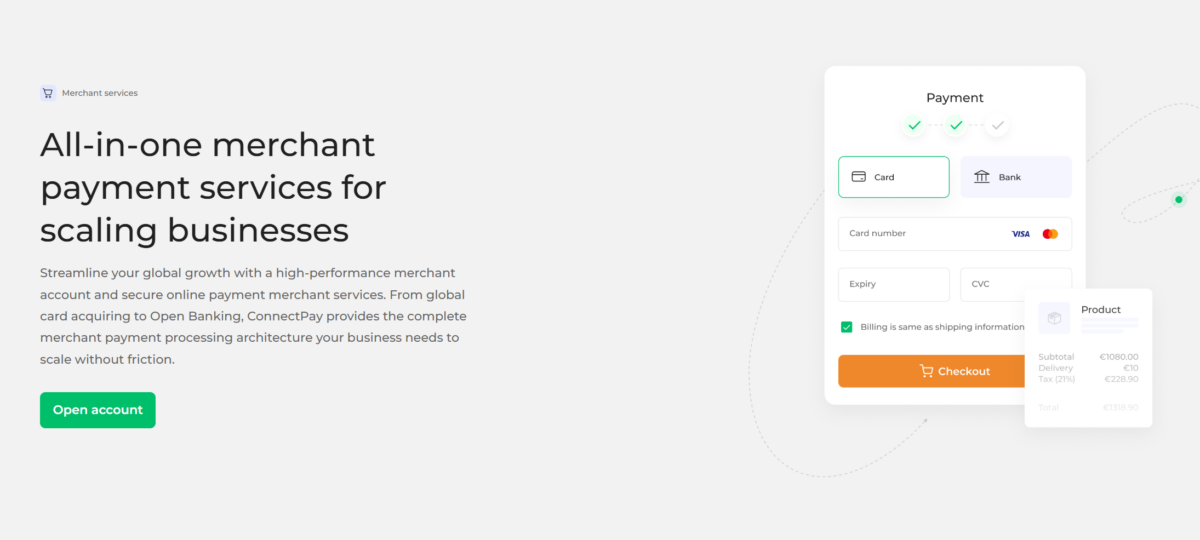
At ConnectPay, we believe that secure and reliable payment infrastructure is the bedrock of business growth. As a compliance-first merchant services provider, we built our platform to support businesses that require a scalable and trustworthy foundation for their transactions. Our approach is anchored in our EU-regulated Electronic Money Institution (EMI) license, which ensures that, as a regulated merchant account provider, our merchant account solutions operate under the highest standards of security and regulatory oversight. This provides our clients with peace of mind, knowing their funds and data are handled within a protected framework. We provide robust merchant account infrastructure that empowers businesses to accept payments from customers around the world.
Our services include full card acquiring capabilities, multi-currency payment support, and a resilient payment processing infrastructure designed for high performance. For tech-forward businesses, our API integrations allow for seamless connections with fintech platforms and custom software, enabling sophisticated payment flows. We position ourselves as the ideal partner for businesses that need reliable merchant account services and global payment infrastructure. Our goal is to be more than just one of the best merchant service providers; we aim to be a long-term partner in your success, providing the tools and expertise you need to thrive in a global marketplace.
2. Stripe
Best for developer-friendly merchant account and payment processing.

Stripe has become a household name in the tech world, largely due to its developer-first philosophy. From what we see, their greatest strength is their powerful and well-documented API, which has set the industry standard for ease of use and flexibility. This allows developers to integrate complex payment flows directly into their websites and applications with relative ease.
Stripe’s platform is designed as a comprehensive toolkit for internet businesses, bundling payment processing with a wide array of complementary services like billing, invoicing, and financial reporting. They offer an impressive global reach, supporting over 135 currencies and a multitude of local payment methods, which is a significant advantage for businesses with international ambitions.
Their extensive library of integrations with e-commerce platforms, SaaS tools, and accounting software makes them an attractive option for businesses that want a plug-and-play solution. While their flat-rate pricing is transparent, it may not be the most cost-effective for very high-volume businesses, who might benefit more from a provider with interchange-plus pricing. Nonetheless, for startups and tech-savvy companies that prioritize flexibility and quick implementation, Stripe remains a top-tier choice.
3. Adyen
Best for enterprise merchant account services.
Adyen has carved out a strong position in the market by focusing on the needs of large, global enterprise businesses. Their key differentiator is their all-in-one platform, which combines a payment gateway, risk management, and acquiring services into a single, integrated system.
This unified commerce approach allows businesses to manage online, in-app, and in-store payments from one central hub, providing a holistic view of customer behavior across all channels. From what we see in the industry, this is incredibly valuable for large retailers and corporations aiming to create a seamless omnichannel experience. Adyen’s global acquiring network is another significant asset, enabling them to process payments locally in major markets around the world.
This can lead to higher authorization rates and lower transaction costs for international sales. Their platform also includes sophisticated fraud protection tools that use machine learning to analyze transaction data and identify risks in real-time. While Adyen’s powerful, feature-rich platform is ideal for enterprise-level clients, it can be more complex and costly than what a small or medium-sized business might need. For large organizations with complex, high-volume payment needs, Adyen is undoubtedly an option to consider.
4. Square
Best for small businesses and in-person payments.

Square revolutionized the payment industry by making it incredibly simple for small businesses to start accepting card payments. Their iconic square-shaped card reader, which plugs into a smartphone or tablet, became a symbol of accessible commerce. Today, their ecosystem has expanded far beyond that initial device.
They offer a comprehensive suite of POS solutions tailored to various industries, such as restaurants and retail, alongside tools for online and offline payment processing. One of Square’s biggest draws is its straightforward merchant account setup and predictable flat-rate pricing, which eliminates the complex fee structures that can be daunting for new business owners.
From our observation, Square excels at providing an all-in-one solution for small brick-and-mortar businesses. Their platform integrates hardware, software, and payment processing seamlessly, and they offer additional services like payroll, marketing, and small business loans. While their transaction fees might be higher than those of other providers for larger businesses, the simplicity and convenience they offer are often a perfect fit for sole proprietors, pop-up shops, and local service providers just getting started.
5. PayPal
Best for online payment acceptance.

PayPal is one of the most recognized and trusted names in online payments, and that brand recognition is its greatest asset. For many consumers, seeing the PayPal button at checkout provides a sense of security and familiarity, which can help reduce cart abandonment.
The platform allows businesses to accept payments from a massive global user base through the PayPal digital wallet, as well as traditional credit and debit cards. Integrating PayPal into an e-commerce website is typically very straightforward, often requiring just a few lines of code or a simple plugin for popular platforms like Shopify or WooCommerce.
From what we’re witnessing, PayPal is an excellent starting point for online businesses or as a supplementary payment option to build customer trust. They offer a range of products, from simple checkout buttons to more comprehensive merchant services that include invoicing and subscription billing. While their fees can be on the higher side, especially for international transactions, the ease of use and the trust it inspires in customers make it an essential payment method for many online merchants. It serves as a powerful tool for converting customers who prefer the convenience and security of its digital wallet.
6. Checkout.com
Best for high-growth online businesses.

Checkout.com has rapidly emerged as a major player in the global payments space, targeting high-growth technology companies and large e-commerce businesses. Their platform is built on a modern, modular payment infrastructure that provides businesses with granular control over their payment flows.
We see them as a strong competitor to other developer-centric platforms, offering powerful and flexible APIs that allow for deep customization. A key strength of Checkout.com is its unified global payment infrastructure, which provides direct acquiring in numerous countries. This allows them to process transactions more efficiently and offer more detailed data insights than providers who rely on a web of third-party processors.
Their platform includes advanced fraud detection tools and comprehensive reporting features that help businesses optimize their revenue. Checkout.com is best suited for larger businesses with the technical resources to leverage its powerful API and that require a sophisticated, data-driven approach to payment processing. For fast-scaling international companies, their ability to handle complex cross-border payments and local payment methods makes them a very compelling choice.
7. Worldpay
Best for large international merchants.
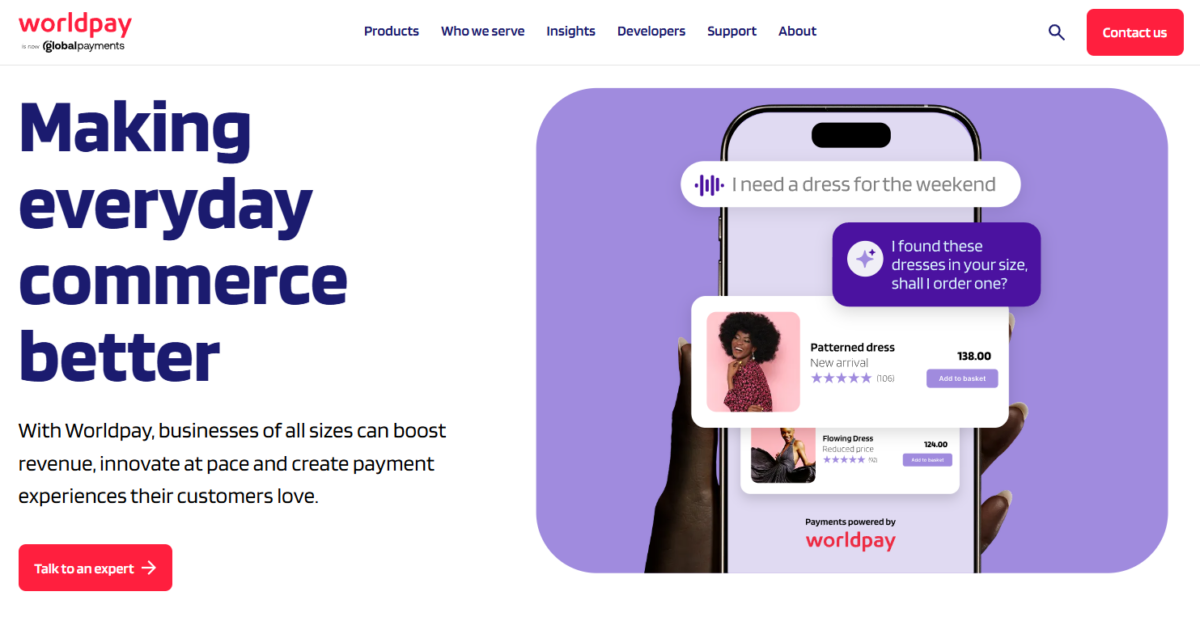
Worldpay, now part of FIS, is one of the oldest and largest payment processors in the world. Their longevity has allowed them to build an extensive global acquiring network and a deep understanding of the complexities of international commerce.
They cater primarily to large, established enterprise merchants, offering a robust and reliable payment infrastructure designed to handle immense transaction volumes. From our industry perspective, Worldpay’s strength lies in its scale and its ability to provide tailored solutions for specific industries, such as retail, travel, and gaming. They offer a wide range of payment services, including online, in-store, and mobile processing, backed by sophisticated risk management and fraud prevention tools.
Their platform supports a vast number of payment methods and currencies, making them a suitable partner for multinational corporations. For smaller businesses, Worldpay’s platform and pricing structure can be complex to navigate. However, for large international merchants that require a proven, industrial-strength payment processor with a global footprint, Worldpay remains a dominant and highly capable option.
8. Payoneer
Best for cross-border merchant payments.
Payoneer has carved out a specific and valuable niche in the payments world by focusing on the needs of freelancers, B2B companies, and online sellers operating in a global context. Their platform excels at facilitating cross-border payments, making it easier for businesses to pay and get paid by international partners and clients.
Rather than focusing solely on customer-to-business checkout, Payoneer specializes in enabling B2B transactions and marketplace payouts. For example, a business can use Payoneer to receive payments from global marketplaces like Amazon or Upwork into a multi-currency account, and then use those funds to pay international suppliers or contractors.
We see their platform as an essential tool for businesses that are deeply embedded in the global digital economy. They offer global payment capabilities in over 190 countries and support more than 70 currencies, simplifying what can otherwise be a complex and costly process. While they may not be the primary choice for a traditional e-commerce storefront, their role in managing international B2B payments, supplier invoices, and marketplace sales makes them an indispensable partner for many modern businesses.
Key Features to Look for in Merchant Service Providers
After reviewing the list, it’s crucial to know how to evaluate these merchant account services providers for your unique business needs. The right choice goes beyond just transaction fees; it’s about finding a partner that provides secure and efficient merchant account solutions to build your revenue on.
- First, examine payment method support. In today’s market, customers expect options. A good provider should support all major credit and debit cards, popular digital wallets, and ideally, local payment methods relevant to your target regions.
- Next, scrutinize the transaction fees and pricing structure. Businesses should compare processing rates, monthly account fees, chargeback costs, and any fees for international transactions to understand the total cost of ownership.
- For businesses with global ambitions, global payment capabilities are non-negotiable. Look for multi-currency payment support and international acquiring to ensure you can sell to customers anywhere.
- Of course, security and compliance are paramount. Your merchant account provider must offer robust fraud prevention tools, be fully PCI compliant, and provide secure payment processing to protect both you and your customers.
- Finally, consider the integration capabilities. The platform should integrate easily with your e-commerce software, accounting tools, and other business systems to streamline your operations.
The best merchant service providers combine reliable payment processing, global capabilities, and strong security infrastructure.
How Merchant Accounts Work for Businesses
For many business owners, what happens after a customer clicks “pay” can seem like a mystery. Understanding how merchant accounts work helps you appreciate the payment infrastructure behind the services.
- When a customer makes a purchase with a card, the transaction details are sent from the payment gateway to the payment processor.
- The processor then communicates with the card network (like Visa or Mastercard) and the customer’s issuing bank to check for sufficient funds and approve the transaction. This approval happens in seconds.
- The funds, however, don’t move immediately. The acquiring bank – the bank that provides your merchant account – collects the approved funds from all your transactions.
- These funds are then deposited into your business bank account in a batch, a process known as settlement. This typically takes one to three business days, though some providers offer faster payout timelines.
Merchant account providers manage this entire complex process on your behalf. They provide the technology, the bank relationships, and the security to ensure that funds move safely from your customers to your business account, allowing you to focus on running your business instead of worrying about payment logistics.
Choose the Right Merchant Service Provider for Your Business
Selecting the right partner for your business is a strategic decision that will have a lasting impact. Reliable merchant account services are not just a utility; they are a fundamental part of your customer’s journey and a key driver of your operational efficiency. The payment infrastructure you choose directly affects the customer experience, transaction success rates, and ultimately, your business growth. A clunky checkout process or a high rate of declined payments can lead to lost sales and damaged brand reputation, while a seamless and secure system can build trust and encourage repeat business.
As you evaluate your options, we encourage you to look beyond the headline rates: add fees, integrations, and global payment support. Also consider the provider’s reputation for reliability, the quality of their customer support, and their ability to scale with you. A partner that works for a small startup may not be the right fit once you begin processing thousands of transactions a day. Exploring a scalable and regulated option like ConnectPay can provide a clear benchmark for what a secure, growth-oriented infrastructure looks like as you plan for the future.
Before you commit, we recommend using this simple checklist:
- Identify all your payment acceptance needs (online, in-person, international).
- Compare the full range of fees and transaction costs, not just the processing rate.
- Evaluate their global payment capabilities and currency support.
- Choose a secure and scalable provider that can support your long-term vision.
FAQs: Top Merchant Service Providers
What are merchant service providers?
Merchant service providers are companies that offer businesses the ability to accept electronic payments, such as credit cards, debit cards, and digital wallets. They provide the necessary technology, security, and financial relationships, including a merchant account, to process transactions safely from the customer to the business.
How do merchant accounts work?
A merchant account is a special type of bank account that temporarily holds funds from approved card transactions. When a customer pays, the funds are first sent to the merchant account. Then, typically within 1-3 days, the funds are transferred in a batch to the business’s regular bank account.
How do businesses decide which wallets to support in each market?
Businesses typically choose which wallets to support based on local market share – Alipay and WeChat Pay in China, iDEAL-linked wallets in the Netherlands, or Apple Pay/Google Pay in most Western markets. Payment processor data on regional wallet usage, along with direct customer research, usually guides which wallets are worth prioritizing for a specific market.
What should businesses look for in a merchant service provider?
Businesses should look for a provider with transparent pricing, strong security and PCI compliance, reliable customer support, and the ability to accept a wide range of payment methods. It’s also important to consider their integration capabilities with your existing software and their ability to support your future growth.
Which merchant service providers support international payments?
Many top providers support international payments, but their capabilities differ. Providers like ConnectPay, Adyen, and Checkout.com have strong global acquiring networks and multi-currency support, which is ideal for businesses with a significant international customer base. Others (like Stripe and PayPal) also offer extensive currency support for online transactions.
What are the best merchant account providers?
The “best” provider depends on your business type. ConnectPay is excellent for businesses needing regulated EU infrastructure. Stripe is a favorite among tech-savvy companies for its powerful API. Square is a go-to for small businesses with in-person sales, and Adyen is a top choice for large enterprise clients.


