













 14 min read
  Last updated: 24 Sep 2026


If you’re reading this, you’ve probably already run into one of Airwallex’s limits — maybe it’s the European compliance depth, maybe it’s the ERP gap, maybe it’s just that your business doesn’t fit the high-volume mold Airwallex is built for. This guide compares nine leading Airwallex alternatives across transfer fees, FX rates, multi-currency support, compliance depth, API capabilities, and business account features, so you can figure out which one actually fits how you operate.
To be fair to Airwallex first: it’s a genuinely strong platform. Zero international transaction fees on local rails, payments reaching over 200 countries in more than 60 currencies, and 95% of payments landing same-day are hard numbers to argue with. But no platform is the right fit for everyone. Airwallex’s ERP connectivity doesn’t go as deep as some competitors’, its European regulatory footprint is less established than providers built specifically around EU licensing, and its pricing structure works better for high-volume operations than for smaller or earlier-stage businesses. If any of that sounds like your situation, one of the options below is worth a closer look — including for teams managing cross-border payments across multiple markets.
Best Airwallex Alternatives: Quick Overview
Short on time? Here’s the fast version. ConnectPay is our pick for the best overall alternative, particularly if you’re operating in or expanding into Europe. Wise wins on transparent, low-cost transfers. Payoneer is built for freelancers and marketplace sellers. Revolut suits mobile-first business banking. OFX is the one to call for large, infrequent transfers. And Ramp is worth a look if finance automation matters more to you than payment infrastructure itself.
9 Best Alternatives to Airwallex
1. ConnectPay
Best for: European businesses and fintech platforms needing a fully EMI-licensed Airwallex alternative with embedded compliance, multi-currency IBANs, and full financial infrastructure.

We’ll say this upfront: we’re ConnectPay, so take the ranking with that in mind. But the reason we come first isn’t marketing — it’s the license. ConnectPay operates as an EMI (Electronic Money Institution) under strict EU regulatory supervision, which gives it a level of European regulatory depth that Airwallex, as a broader global platform, doesn’t quite match. That distinction matters more than it sounds — it determines who holds your funds, how they’re safeguarded, and how quickly you can operate compliantly across EU markets.
On the practical side, ConnectPay offers multi-currency IBAN accounts covering 80+ currencies for holding and receiving funds, along with SEPA and SEPA Instant connectivity that settles European payments at 0% on local rails, plus SWIFT access for transfers further afield. AML and KYC compliance is built into the platform itself rather than bolted on, which takes a meaningful operational burden off your team’s plate. For platforms that need to go deeper than a payment tool, ConnectPay’s API-first architecture supports ERP and platform integrations that go further than what Airwallex currently offers, and card issuing — business, virtual, and white-label cards — extends past Airwallex’s corporate card offering. Add fraud monitoring and dedicated account management, and you get a genuine business account infrastructure rather than a single-purpose payments layer.
If you’re a fintech platform, marketplace, SaaS business, or scaling European company that needs EMI-licensed infrastructure and embedded compliance rather than just a payment operations tool, this is where we think ConnectPay earns its place at the top of this list.
2. Wise Business
Best for: Businesses needing transparent low-cost international transfers with mid-market exchange rates and no monthly fees.

Wise built its reputation on one thing: showing you exactly what a transfer costs before you send it. Wise Business supports payments to over 160 countries with no monthly fees, and it uses the mid-market exchange rate rather than marking up currency conversion the way many providers do — a direct contrast to Airwallex’s fee structure, which bundles costs differently depending on the rail. Instead of a flat markup, Wise charges a fixed fee plus a variable percentage per transfer, which makes cost forecasting straightforward if you’re sending similar amounts regularly. You can send directly to bank accounts in 70+ of those 160+ countries, which covers most standard corridors.
Where Wise falls short of Airwallex is on the business tooling side — it doesn’t offer the same depth of business management features or API capabilities that platforms need for embedded finance or complex workflow automation. If you’re weighing it against Stripe specifically, that’s a different comparison worth reading on its own; here, the relevant question is Wise versus Airwallex, and the honest answer is that Wise wins on transparency and simplicity, while Airwallex wins on scale and infrastructure depth.
3. Revolut Business
Best for: Digital-first businesses needing a feature-rich multi-currency business account with strong mobile experience.

Revolut plays in similar territory to Airwallex — multi-currency accounts, business banking features, an app-first experience — but it leans harder into the consumer-facing side of business banking. Budgeting tools, spend analytics, and in-app support give teams visibility that a pure payments platform doesn’t always provide. On pricing, Revolut’s Basic plan charges 1% plus 20p per transaction, which is worth comparing directly against whatever tier of Airwallex you’d otherwise use.
The trade-off is tiered pricing: many of the features that make Revolut appealing sit behind paid plans, so the free tier gets you less than it might first appear. And on the regulatory side, Revolut’s European coverage isn’t as deep as what you get from an EMI-licensed provider built specifically around EU supervision. If in-app banking convenience matters more to your team than infrastructure depth, Revolut is a reasonable middle ground between Airwallex and a dedicated EMI.
4. Payoneer
Best for: Freelancers, agencies, and marketplace sellers needing low-cost international payment collection with strong marketplace integrations.
Here’s the honest comparison people usually want: Airwallex or Payoneer? Airwallex is the stronger choice if you need global payment infrastructure and expense management built around a growing business. Payoneer is the better fit if you’re a freelancer, agency, or marketplace seller who just needs to receive payments from platforms like Amazon, Upwork, or Fiverr without setting up a full banking stack.
Payoneer lets you hold balances in 30+ currencies, which covers most of what an independent seller or small agency needs. The catch is on fees: receiving payments can cost up to 4%, which adds up quickly if you’re processing high transaction volumes rather than occasional payouts. Its integrations with major marketplaces are genuinely strong, and that’s really the point of Payoneer — it’s built to plug into where freelancers and sellers already get paid, not to be a general-purpose business banking platform.
5. OFX
Best for: Businesses making large, infrequent international transfers needing zero transfer fees and dedicated account management.
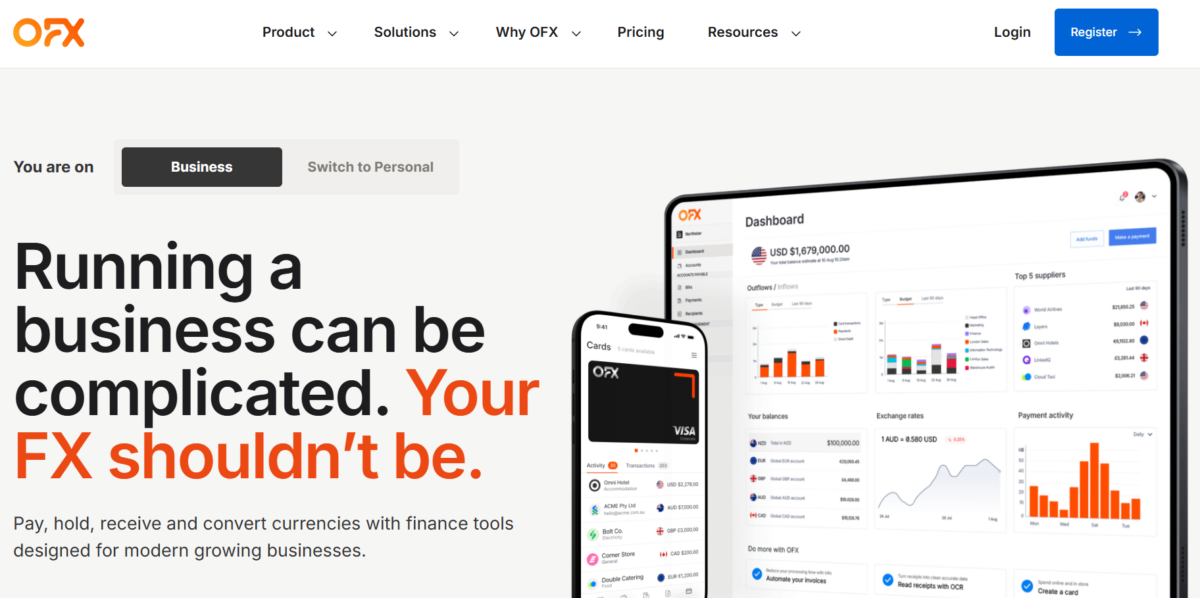
If your business sends a handful of large payments a year rather than a steady stream of smaller ones, OFX solves a different problem than Airwallex does. It specializes in exactly that: large, infrequent transfers, with no transfer fees on most transactions over $1,000. That fee structure flips Airwallex’s model on its head — Airwallex is built for volume, OFX is built for size.
The trade-off is speed. OFX transfers typically take 1 to 2 business days, noticeably slower than Airwallex’s same-day rate, but for a business making a few big transfers a year rather than daily payment runs, that delay is rarely a dealbreaker. What you get in return is 24/7 personalized support — a real person you can call, not just a chat widget — which matters more than people expect when a six-figure transfer is on the line. If your payment operations involve daily, high-volume transactions, though, OFX isn’t the right shape for your business.
6. Stripe
Best for: Developer-first businesses needing global payment acceptance infrastructure with strong API capabilities.

Stripe and Airwallex get compared constantly, and the confusion is understandable because they overlap in places without actually solving the same problem. Airwallex is stronger for multi-currency accounts and global payouts — moving money out. Stripe is stronger for payment acceptance and developer flexibility — bringing money in. If your business primarily needs to accept payments from customers around the world, Stripe’s ecosystem is hard to beat: it supports over 100 payment methods and 135+ currencies, backed by documentation that’s become something of an industry benchmark for developer experience.
Where Stripe doesn’t compete directly is on the accounting side. It’s not built to sync natively with ERP systems the way a platform like Ramp does with QuickBooks, NetSuite, and Xero — that’s simply not what Stripe is for. So it’s worth being clear-eyed here: Stripe isn’t a like-for-like Airwallex alternative in the strictest sense. It serves an overlapping but distinct need, and plenty of businesses end up using both rather than choosing one over the other.
7. Ramp
Best for: Finance teams needing spend management and expense automation alongside global payment capabilities.

Ramp solves a problem Airwallex doesn’t really try to solve: what happens to money once it’s inside your business. It’s a finance automation platform, holding a 4.8-star rating, built around corporate cards and expense management rather than cross-border payment infrastructure. Where it directly addresses a gap in Airwallex’s offering is ERP connectivity — Ramp syncs seamlessly with QuickBooks, NetSuite, and Xero, closing a hole that shows up repeatedly in Airwallex reviews from finance teams.
That said, Ramp isn’t a payment processor in the way the rest of this list is. It’s better suited to teams managing internal spend — who’s swiping which card, where the budget is going — than to businesses that need to move money across borders. Most teams that use Ramp pair it with a separate payments platform rather than expecting it to replace one.
8. Fyorin
Best for: Businesses needing automated accounts receivable and payables across multiple currencies and entities.

Fyorin is a narrower tool than most on this list, and that’s by design. It automates accounts receivable and payables specifically for businesses juggling multiple legal entities and currencies at once — the kind of setup that gets messy fast with spreadsheets or generic banking tools. If you’re running finance across several subsidiaries and need one system tracking who owes what in which currency, Fyorin fills that gap directly.
It’s less well-known than the other providers here, and it’s not trying to be a full Airwallex replacement. But for the specific problem of multi-entity payables and receivables, it competes seriously in the same global payment automation space Airwallex operates in — just from a more specialized angle.
9. Amnis
Best for: European businesses needing competitive FX rates and multi-currency payment management with strong European coverage.

Amnis makes its case on price. FX rates start from 0.2% above the interbank rate, which is aggressive pricing even against providers that market themselves on transparency. For a European business with regular currency conversion needs — say, paying suppliers in multiple EU countries every month — that margin adds up to real savings over a year.
The trade-off is reach. Amnis doesn’t have Airwallex’s global footprint, so if your payment needs extend well beyond Europe, you’ll likely hit limits Airwallex wouldn’t impose. But within its lane — European businesses managing multi-currency payments and regular FX conversion — Amnis is a genuinely strong, cost-focused option.

Ready to upgrade your payment infrastructure?
Stop struggling with fragmented payment flows. Access dedicated IBANs, SEPA Instant, and seamless API integrations – all from a single, unified platform.
Best Airwallex Alternatives: Comparison
| Provider | Best For | Transfer Fees | Multi-Currency | ERP Integration | Compliance Depth |
|---|---|---|---|---|---|
| ConnectPay | European fintechs & platforms | 0% on SEPA/SEPA Instant | 80+ currencies | Strong API-first integration | EMI-licensed, embedded AML/KYC |
| Wise | Low-cost transfers | Fixed fee + variable % | Mid-market rates, 160+ countries | Limited | Standard |
| Revolut | Mobile-first banking | 1% + 20p (Basic plan) | Multi-currency accounts | Limited | Growing, less EU-deep |
| Payoneer | Freelancers & marketplaces | Up to 4% to receive | 30+ currencies | Marketplace-focused | Standard |
| OFX | Large, infrequent transfers | Free over $1,000 | Wide currency support | Limited | Standard |
| Stripe | Payment acceptance | Varies by method | 135+ currencies | Not ERP-focused | Standard |
| Ramp | Finance automation | N/A (not a processor) | N/A | QuickBooks, NetSuite, Xero | Standard |
| Fyorin | Multi-entity AR/AP | Varies | Multi-currency, multi-entity | Entity-level automation | Standard |
| Amnis | European FX pricing | From 0.2% above interbank | Strong EU coverage | Limited | Standard |
Why Consider Airwallex Alternatives?
Airwallex earns a lot of its reputation fairly: 0% fees on local rails, a genuinely global footprint, and an API strong enough that plenty of platforms build directly on top of it. So why look elsewhere at all? A few real gaps show up once you dig in.
- Airwallex integrates with Xero, but that’s about as far as its ERP connectivity goes — if your finance stack runs through QuickBooks or NetSuite, you’ll feel that limitation.
- Its European regulatory depth also isn’t as established as providers built specifically under EU EMI supervision, which matters if compliance is a core part of your business model rather than a checkbox.
- On cost, UK card payments run 1.3% plus 20p, which isn’t always the cheapest option if your business processes a high volume of card transactions rather than bank-to-bank transfers.
- And Airwallex’s whole design leans toward high-volume business transactions, which can make it feel oversized — and priced accordingly — for smaller or early-stage platforms that don’t need that scale yet.
None of this makes Airwallex a bad platform. It just means the fit depends heavily on where your business sits today.
Airwallex vs Competitors: Key Comparison Points
Put side by side, the differences get clearer fast.
- On fees, Airwallex charges 0% on international transactions over local rails, Wise charges a fixed fee plus a variable percentage, PayPal’s international fees can climb past 6%, and Payoneer charges up to 4% just to receive payments.
- Speed tells a similar story: Airwallex settles 95% of payments same-day, Wise often clears transfers in under a minute on many corridors, and OFX takes 1 to 2 business days — a fair trade for its fee savings on large transfers.
- Currency and country coverage varies just as much. Airwallex spans 60+ currencies across 200+ countries, Wise reaches 160+ countries, and Payoneer supports 30+ currencies — each built around a different scale of operation.
- On compliance, ConnectPay’s EMI license brings embedded AML and KYC directly into the platform, while Airwallex’s regulatory coverage, though growing, is less established across the EU specifically.
- And on the accounting side, Ramp’s seamless sync with QuickBooks, NetSuite, and Xero directly addresses the ERP gap that shows up in Airwallex’s Xero-only integration.
None of these providers are strictly better or worse — they’re built around different operating models, which is exactly why understanding the fundamentals of international business payments matters before you commit to one.
How to Choose the Best Airwallex Alternative
Start with your actual use case, not the feature list. Are you moving money across borders as core infrastructure, managing internal expenses, handling marketplace payouts, or building embedded financial services into your own platform? Each of those points toward a different provider on this list.
Compliance requirements should weigh heavily if you’re operating in Europe — businesses here generally need EMI-licensed providers with embedded AML and KYC built in, not a general payment operations platform layered with compliance as an afterthought. Transfer volume matters just as much: high-volume businesses benefit from 0% local rail fees, while lower-volume businesses making occasional large transfers may come out ahead with OFX’s zero-fee structure instead.
Don’t skip accounting integration. Airwallex integrates with Xero but stops there, while a platform like Ramp offers deeper ERP sync if that’s a priority. Multi-currency depth varies too — Airwallex covers 60+ currencies, ConnectPay covers 80+, and Payoneer covers 30+, so match the number to how many markets you actually operate in, not how many you might someday. If you’re building a platform rather than just using one, check API capabilities for embedding directly into your own product. And weigh support quality: Airwallex offers dedicated account management, while OFX goes further with 24/7 personalized support for high-value transfers.
Broadly, it breaks down like this. European fintech platforms building on regulated infrastructure tend to land on ConnectPay for its EMI licensing and embedded compliance. Freelancers and marketplace sellers usually do better with Payoneer’s platform integrations and lower entry costs. Finance teams focused on expense automation and ERP sync gravitate toward Ramp. And businesses making high-value, infrequent transfers tend to find OFX’s zero fees and dedicated support worth the extra day or two in transfer speed. If compliance is a genuine concern rather than a formality, it’s worth reading through how financial service compliance actually works before locking in a provider.
Find the Right Airwallex Alternative for Your Business
There’s no single best Airwallex alternative — there’s only the one that fits your business model, target markets, compliance needs, and payment volume. Airwallex remains a strong global payment operations platform, and for many businesses it’s genuinely the right call. But if you need deeper European compliance coverage, embedded finance infrastructure, or ERP integration that goes beyond Xero, one of the alternatives above is likely to serve you better.
If pure cost efficiency on international transfers is your main concern, Wise and OFX are the strongest fee-focused picks on this list. Whichever direction you go, look past the headline transfer fee — factor in FX margins, compliance costs, and integration complexity too, since those add up over a year in ways a single transaction fee never shows. We put together more on what we do at ConnectPay if European infrastructure and embedded compliance turn out to be what you need.


