













 14 min read
  Last updated: 2 Oct 2026


Card issuing platforms let non-banks launch their own branded payment cards without building banking infrastructure. You connect through an API, design your card, and start issuing virtual and physical cards to customers or employees. The platform handles the bank sponsorship, card scheme rules and processing in the background.
At ConnectPay, we run Cards-as-a-Service for fintechs and platforms across Europe. We see the same mistake again and again: teams pick a provider by brand name, then discover it doesn’t support their card type or market. A US expense card platform won’t help a Lithuanian neobank. A commercial-only API won’t run a consumer debit program.
This guide helps you avoid that. We explain what card issuing platforms do, which features matter, and how 10 top card issuing platforms compare on card types, markets and fit. We also cover credit card issuing platforms and the compliance work you should expect.
What Are Card Issuing Platforms?
Card issuing platforms are programmable interfaces to financial accounts. Through an API, you create cards, set spending rules and manage each card from activation to cancellation. Most card issuance software supports both virtual cards for online payments and physical cards for in-store spending.
A wide range of businesses use them:
- Fintechs launch debit cards linked to their app’s accounts.
- Banks modernize old card programs without replacing their core systems.
- SaaS companies add corporate cards to their expense or accounting tools.
- Marketplaces pay sellers or gig workers onto branded cards.
- Enterprises issue employee cards with built-in spending limits.
The big shift is this: card issuance is no longer limited to banks. Card issuing platforms work with licensed issuers and card schemes, so you can offer branded payment cards without becoming a bank yourself. For many fintechs, that turns a two-year licensing project into a product launch measured in weeks or months.
Key Features of Card Issuing Platforms
Not all card issuance solutions offer the same depth. Before you compare providers, check for these features.
- Real-time transaction controls. You should approve or decline transactions as they happen, based on rules you set. For example, you might limit a card to fuel stations or cap spend at €200 a day.
- Instant virtual card creation. A strong virtual card issuing platform creates a card in seconds, ready for online payments straight after sign-up. Our virtual cards work this way.
- Digital wallet integration. Customers expect to add cards to Apple Pay and Google Pay right away, often before the physical card arrives.
- Full lifecycle management via API. You should be able to issue, freeze, replace and cancel cards through the API, without contacting support.
- Automated expense reconciliation. Corporate card programs need transaction data that flows straight into accounting tools.
Behind these features sit some fixed rules. Every card you issue must map to a BIN (bank identification number) under card scheme rules. Your program needs a clear fund flow: whose money sits where, and under which license. And any provider handling card data must hold PCI DSS certification.

Ready to upgrade your payment infrastructure?
Stop struggling with fragmented payment flows. Access dedicated IBANs, SEPA Instant, and seamless API integrations – all from a single, unified platform.
Best Card Issuing Platforms: Quick Overview
Here are our picks by use case:
- Best overall card issuing platform: ConnectPay
- Best for enterprise-scale programmable control: Marqeta
- Best for teams already on Stripe: Stripe Issuing
- Best for large, complex programs: Galileo
- Best for developer-first teams: Lithic
- Best for unified credit/debit/prepaid: Highnote
- Best for global issuing + acquiring: Adyen
- Best for multi-currency global issuance: Paymentology
- Best for EU card programs: Wallester
- Best for multi-currency wallets and expense management: Airwallex
10 Best Card Issuing Platforms
Each platform below solves a different problem. We’ve focused on who each one suits best, so you can shortlist two or three that match your program.
1. ConnectPay
Best for: European fintechs and platforms wanting card issuing combined with accounts, payments, and compliance under one EMI license.

We’re an electronic money institution (EMI) licensed by the Bank of Lithuania. Our platform combines card issuing with accounts and payments, all under our license.
Most card issuing platforms do one job: they issue and process cards. You then source accounts, payments and compliance from other vendors. We bundle those parts together. Our card issuance solutions include:
- White-label card issuing for virtual and physical cards under your brand
- Multi-currency IBAN accounts that hold the funds behind each card
- Embedded AML and KYC checks inside your onboarding flow
- An API-first setup, so your developers work with one integration
Here’s a workflow we see often. A marketplace onboards a new seller. The seller passes KYC, gets an IBAN account and receives a virtual card in the same flow. Payouts land in the account, and the seller spends them on the card. One provider, one contract, one API.
That’s the main difference from single-purpose card issuing APIs and from the processors in our list of credit card processing companies.
Are we among the best card issuing platforms for every program? No. If you need US consumer credit cards, look elsewhere on this list. But for fintechs, marketplaces and platforms scaling across Europe, we offer one of the most complete setups available.
2. Marqeta
Best for: Enterprises needing deep programmable control over card programs, powering products like Square, Affirm, and DoorDash.

Marqeta has supported card programs since 2010. Square, Affirm and DoorDash all use its platform.
It’s an open API platform built around three strengths. It supports instant issuance, so customers get cards right away. It offers real-time controls, so you decide what each card can buy. And it supports just-in-time funding, which moves money onto a card only at the moment of purchase.
Just-in-time funding explains why delivery apps like it. A courier’s card holds zero balance until checkout. Marqeta then funds the exact order amount, and the courier pays.
Among the top card issuing platforms, Marqeta is the enterprise pick. It fits complex, high-volume programs where the card sits at the core of the product. Smaller teams may find its depth more than they need at launch.
3. Stripe Issuing
Best for: Teams already built on Stripe wanting fast time-to-market for employee or expense cards.
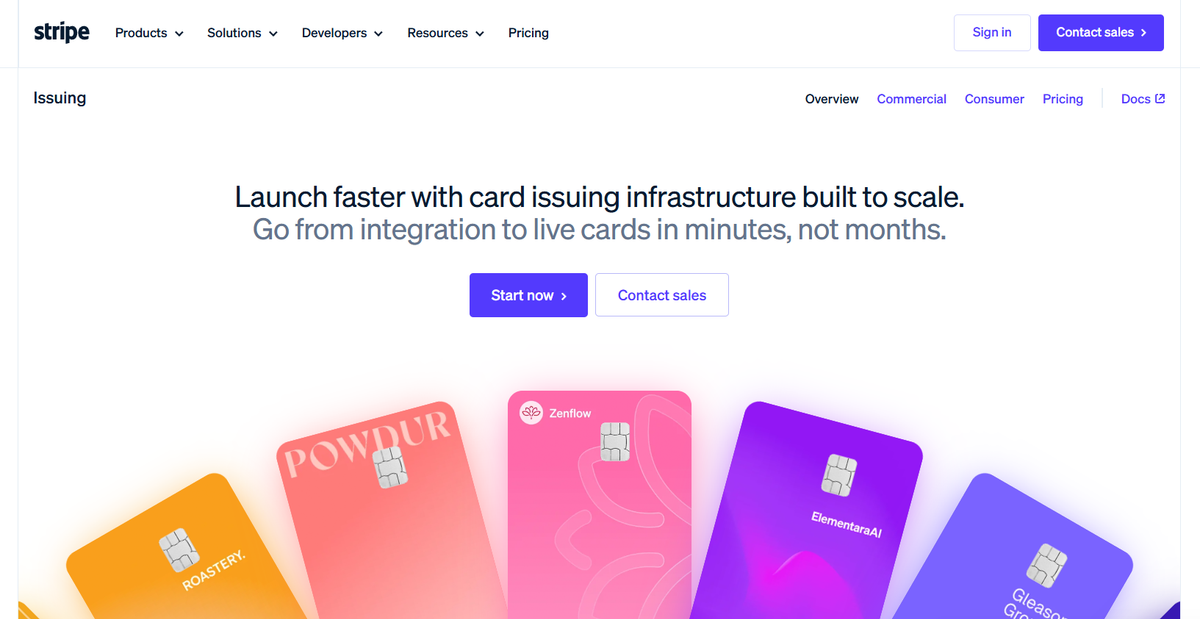
If your product already runs on Stripe, Stripe Issuing is the shortest path to cards. It offers a programmable API for creating and managing virtual and physical cards, with built-in fraud controls and spend limits. You keep the same dashboard and tools.
That makes it a fast virtual card issuing platform for expense use cases. A SaaS spend tool might issue a card per vendor subscription, each with its own monthly cap. A startup might give every employee a card with a travel budget attached.
Note one key limitation. Stripe built Issuing for commercial and expense use cases, not consumer-facing card programs. If you plan to give debit cards to the public, Stripe Issuing isn’t the right tool. Check current availability with Stripe for your country, too, as coverage varies by market.
4. Galileo
Best for: Large-scale programs needing bank-processor-grade infrastructure and deep API capabilities.

Galileo has been in card issuing and digital banking for a long time, and SoFi owns it today.
Developers rate its APIs well, and its compliance depth stands out. Its long track record also reassures partner banks and regulators when they review a new program. Galileo supports debit, prepaid and credit programs. That puts it among the stronger credit card issuing platforms for US businesses that want to offer lending products alongside debit cards.
Picture a digital bank with millions of customers. It needs debit cards, a secured credit card for customers building credit, and detailed controls for fraud and disputes. Galileo handles that kind of complexity well.
The trade-off is weight. Galileo suits complex, large-scale programs more than lean, fast launches.
5. Lithic
Best for: Developer-first teams wanting flexible funding models and lean, fast integration.

Lithic grew out of Privacy.com, the virtual card company founded in 2014. It took that experience and turned it into developer-first card issuance software for other businesses.
Its APIs cover the full card lifecycle: issuing, controls, authorizations and disputes. Developers often point to its documentation as a reason they chose it.
Lithic also offers flexible funding models. You can fund cards from your own bank account or work with Lithic’s issuing bank partners, depending on your program.
A typical Lithic client is a seed-stage startup with two engineers and a clear card idea. The team wants a working prototype in days, not months.
It’s the fast, lean option for startups with real card program ambitions.
6. Highnote
Best for: Businesses wanting credit, debit, and prepaid card issuing on a single unified platform.

Most card issuing companies started with one card type and added others later. Highnote built all three from the start. Its embedded finance platform offers credit, debit and prepaid card issuing through one graph-based API.
A unified ledger sits underneath. Every card type and every transaction flows into the same record. That makes reporting and reconciliation simpler than stitching data together from several systems.
Here’s where that helps. A fleet company wants prepaid fuel cards for drivers, debit cards for contractors and a credit line for its biggest customers. With separate vendors, that’s three integrations. With Highnote, it’s one.
Highnote suits businesses that plan to offer several card types and don’t want to manage several providers to do it.
7. Adyen
Best for: Global enterprises wanting issuing and acquiring unified on one platform.
Adyen is best known for accepting payments. Adyen Issuing adds the other side. It lets businesses issue Visa and Mastercard cards through the same platform they use for acquiring.
That combination is rare. Most of the best card issuing platforms only issue cards. With Adyen, a business can take payments from customers and pay out funds onto cards in one system.
A large marketplace shows why this matters. It accepts card payments from buyers, then issues cards to sellers so they can spend their earnings. With issuing and acquiring in one place, the finance team reconciles everything from one data source.
Adyen fits enterprises that already process high volumes and want tighter control across the whole money flow.
8. Paymentology
Best for: Businesses needing global, multi-currency card issuance with real-time program controls.

Paymentology combines card issuing and processing in one platform. It supports debit, credit and prepaid programs across many currencies and countries.
Real-time controls run through the whole platform. Program managers can set and change rules instantly, from spending limits to merchant category blocks.
Its strength is reach. Paymentology works with banks and fintechs in many regions, which makes it one of the more practical credit card issuing solutions for programs that cross borders. A digital bank launching in several emerging markets at once, for example, can run each market’s program on the same platform.
It suits businesses with international card program needs, especially where a single-market provider would force them to add vendors country by country.
9. Wallester
Best for: European businesses needing fast virtual and physical card issuance within the EU.

Wallester is a European card issuing platform with a clear regional focus. It’s known for issuing virtual and physical cards quickly within the EU.
For businesses that operate mainly in Europe, that focus helps. Wallester covers the European rules, schemes and customer expectations that a US-first provider might handle less smoothly.
A common use case is a European company issuing corporate cards to its teams. A travel agency, for example, might create a virtual card for each booking and close it once the trip ends.
Wallester ranks among the best card issuance platforms for EU-based programs. If you plan to expand beyond Europe, check its coverage against your roadmap before you commit.
10. Airwallex
Best for: International businesses wanting card issuance linked to multi-currency wallets and expense management.

Airwallex built its business on international payments, and its cards follow that focus. Each card links to a multi-currency wallet, so businesses can spend in local currency without heavy FX fees.
Airwallex also ties cards to expense management. Finance teams can issue cards, set budgets, collect receipts and track spend in one place.
Think of a company with teams in Singapore, London and Sydney. Each team spends in its own currency from the same account. Finance sees everything in one dashboard at month-end.
That makes Airwallex one of the best card issuance solutions for businesses whose card programs tie closely to global expense management.
Card Issuing Platforms: Comparison
Here are all 10 platforms side by side. Coverage changes often, so confirm details with each provider.
| Provider | Best For | Card Types Supported | Geographic Focus |
|---|---|---|---|
| ConnectPay | Issuing plus accounts and compliance | Virtual and physical debit | Europe |
| Marqeta | Enterprise programmable control | Debit, prepaid, credit | Global, US-led |
| Stripe Issuing | Teams on Stripe | Virtual and physical commercial cards | US, UK, parts of Europe |
| Galileo | Large, complex programs | Debit, prepaid, credit | US-led |
| Lithic | Developer-first teams | Debit, prepaid, credit | US |
| Highnote | Unified card types | Debit, prepaid, credit | US |
| Adyen | Issuing + acquiring | Virtual and physical | Global |
| Paymentology | Multi-currency issuance | Debit, prepaid, credit | Global |
| Wallester | EU card programs | Virtual and physical | Europe |
| Airwallex | Global expense management | Virtual and physical multi-currency | Global |
Benefits of Card Issuing Platforms
Why launch a branded card at all? Because a card turns occasional users into daily ones.
- Stronger loyalty. A branded card puts your name in front of customers every time they pay.
- Interchange revenue. Each time a cardholder pays, the merchant pays a small fee, and part of it reaches the card program. Across thousands of cardholders, that becomes a real revenue line.
- Purchasing data. You see where customers spend, how often and how much. That shapes better offers.
- No infrastructure build. Card issuing platforms give you all of this without building processing systems or getting scheme certification yourself.
At scale, card programs can earn serious money. When United Airlines and Chase extended their co-brand card deal through 2029, United said the new terms would add around $400 million in revenue in 2019 alone. Most fintech programs won’t reach that size. But the example shows why so many B2B payment platforms and consumer apps now add cards.
Security and Compliance Considerations
Card programs carry real compliance work. Here’s what card issuing companies have to manage:
- PCI DSS compliance for every system that stores, processes or transmits card data
- KYC and AML checks to verify each cardholder and monitor transactions for financial crime
- Encryption and tokenization to protect card numbers in storage and in transit
- Two-factor authentication for cardholder logins and sensitive actions
- Ongoing compliance audits by schemes, regulators and partner banks
None of this is a one-off task.
The good news: this is exactly what a strong card issuing platform should absorb for you. You shouldn’t need your own PCI audit team or build a monitoring system from scratch. When you compare providers, ask which of these items they handle, which they share with you, and which sit fully on your side.
How to Choose the Best Card Issuing Platform
The best card issuing platforms for your program depend on four questions.
Is your program consumer-facing or commercial? This rules providers in or out fast. Stripe Issuing, for example, focuses on commercial cards.
Where are your cardholders, and in which currencies do they spend? A European program needs EU coverage and euro accounts. An international expense program needs multi-currency support.
Which card types do you need? Some platforms do debit and prepaid only. Others add credit.
How much compliance work do you want to handle? Some providers absorb most of it. Others expect you to run KYC, monitoring and disputes yourself.
Here’s how we’d match readers to the best card issuance platforms:
- European fintechs wanting issuing plus accounts and compliance in one place: ConnectPay
- Enterprises with complex, high-volume programs: Marqeta or Galileo
- Startups already on Stripe: Stripe Issuing
- Developer-first teams wanting lean integration: Lithic
- International businesses needing multi-currency card programs: Airwallex or Paymentology
For a wider look at providers beyond cards, see our guide to the best fintech API companies.
Launch a Card Program Built on the Right Infrastructure
The right platform depends on your program, not on the biggest name. Is your card for consumers or for business spend? Which markets do you serve? How much compliance work do you want handled for you? Answer those three questions, and your shortlist gets short fast.
For European businesses that want card issuing combined with accounts, payments and compliance in one platform, we believe ConnectPay offers the most complete starting point. Our white-label card issuing lets you launch branded virtual and physical cards under our EMI license, through one API.
Whichever provider you pick, check its card type support and geographic coverage against your real roadmap, not just your launch plan. To see how cards fit with the rest of our platform, visit ConnectPay.


