













 17 min read
  Last updated: 1 Oct 2026


B2B payment platforms are no longer just about sending money – they’re about managing how money moves across your entire business. If you’ve ever handled supplier invoices, international transfers, or bulk payouts, you already know this isn’t that simple.
B2B payments come with different challenges than consumer payments. Instead of one-off transactions, you’re dealing with invoice approvals, scheduled payments, higher transaction values, and multiple stakeholders involved in every step. Add cross-border payments, and suddenly you’re managing currencies, FX rates, and compliance requirements at the same time.
A typical workflow might look like this: a finance team approves a batch of invoices, schedules payments in multiple currencies, and needs everything reconciled automatically in their system. Doing this manually doesn’t scale. That’s why businesses are moving toward modern B2B payment providers. These platforms automate payment execution, reduce operational overhead, and connect directly to internal systems like ERPs or accounting tools.
In this guide, we compare 11 of the best B2B payment platforms and payment processing solutions. The focus is simple – what actually helps teams move money faster, stay compliant, and scale without friction.
Best B2B payment platforms: quick answer
If you want the short version: ConnectPay is the best EU-regulated B2B payment platform for businesses prioritizing compliance and scalable infrastructure. Stripe is the top choice for developer-friendly integrations, while Wise Business works well for transparent international transfers. Payoneer is a strong option for cross-border payouts, and Adyen is best suited for enterprise B2B payment processing at global scale.
B2B payment platforms comparison
| Platform | Best For | Payment Types | Global Support | Integration |
|---|---|---|---|---|
| ConnectPay | Regulated B2B infrastructure | Bank transfers, cards, multi-currency | Europe/Global | API & modular |
| Stripe | Flexible B2B payment integration | Cards, bank debits, invoicing | Global | API-first |
| Adyen | Enterprise B2B payment processing | Cards, bank transfers | Global | Advanced APIs |
| Payoneer | Cross-border B2B payments | Transfers, local payouts | Global | Platform integrations |
| Airwallex | International payment infrastructure | Transfers, FX, cards | Global | API & dashboard |
| Wise Business | Low-cost international transfers | Bank transfers, multi-currency | Global | API & dashboard |
| Checkout.com | High-growth global businesses | Cards, digital payments | Global | API-driven |
| Worldpay | Large enterprise payment processing | Cards, bank transfers | Global | Enterprise setup |
| Tipalti | Automated B2B payouts | Mass payouts, transfers | Global | API & ERP |
| Rapyd | Alternative payment methods | Local methods, wallets | Global | API |
| PayPal Business | Simple online B2B payments | Cards, wallet, invoicing | Global | Plug-and-play & API |
| Nickel | Cash-flow management for U.S. | ACH, cards, wires, checks | U.S./135+ countries | Native integrations & AI assistant |

Ready to upgrade your payment infrastructure?
Stop struggling with fragmented payment flows. Access dedicated IBANs, SEPA Instant, and seamless API integrations – all from a single, unified platform.
12 best B2B payment platforms
1. ConnectPay
Best for regulated B2B payment infrastructure for global businesses

B2B payments get complex fast. You’re not just sending money – you’re managing invoices, handling approvals, moving funds across borders, and making sure everything stays compliant. That’s exactly where ConnectPay fits among modern b2b payment platforms.
We built ConnectPay as infrastructure, not just a payment tool. Operating under an EU-regulated EMI license, the platform is designed to support secure and compliant b2b payments from the ground up. This matters when you’re dealing with higher transaction values and strict regulatory requirements.
Multi-currency accounts make it easier to manage international transactions without constantly converting funds. Businesses can send and receive payments globally while keeping operations centralized and predictable.
On the processing side, ConnectPay combines payment acceptance with integrated card acquiring and gateway functionality. This allows companies to handle payments within one system instead of relying on multiple providers. Connectivity is another key advantage. With direct support for SEPA and SWIFT, businesses can move funds efficiently across regions.
For platforms and fintechs, APIs make it possible to embed b2b payment processing solutions directly into internal systems or products. If you’re building global business to business payment solutions, having a reliable payment gateway is what keeps everything scalable.
2. Stripe
Best for developer-friendly B2B payment integration

Stripe is often the go-to platform when teams want flexibility in how B2B payments are handled. It’s built around APIs, which makes it easy to design custom payment flows instead of relying on fixed systems.
At its core, Stripe supports global payment processing across multiple currencies and regions. This makes it a strong fit for companies working with international clients or suppliers. Payments can be accepted via cards, bank debits, or invoices, all within one platform.
Where Stripe stands out is its API-driven infrastructure. Teams can build tailored workflows – for example, automatically generating invoices, collecting payments, and syncing data with internal systems. A common setup looks like this: a SaaS company issues monthly invoices, Stripe handles payment collection, and everything is recorded automatically for reconciliation.
It also includes built-in invoicing and billing tools, which simplify recurring payments and subscription-based B2B models. That said, flexibility comes with responsibility. As payment logic becomes more complex, teams need to manage configuration and optimization, but for businesses that want scalable B2B payment processing, Stripe remains one of the most adaptable platforms available.
3. Adyen
Best for enterprise B2B payment processing
Adyen is built for businesses that operate at scale and need full control over global payment operations. It’s not designed as a plug-and-play solution – it’s designed for companies handling large transaction volumes across multiple regions.
One of its biggest strengths is its global acquiring network. Instead of routing payments through multiple intermediaries, Adyen connects directly to local acquiring in many markets. This helps improve authorization rates and makes payment processing more efficient.
Multi-currency support is built into the platform, allowing businesses to accept and settle payments across different regions without fragmented systems. For example, a company invoicing clients in USD, EUR, and GBP can manage all payments centrally while keeping reporting consistent.
Adyen also offers advanced fraud protection tools. These systems analyze transaction data in real time to detect suspicious activity and reduce chargebacks – something that becomes critical as payment volumes increase. The platform requires more technical resources to implement, but that’s expected at the enterprise level.
For large businesses that need global reach, Adyen provides a robust and scalable B2B payment infrastructure.
4. Payoneer
Best for cross-border B2B payments
Payoneer is built around one core need – sending and receiving payments globally without friction. For businesses working with international partners, suppliers, or marketplaces, this becomes a key part of daily operations.
Its global payouts network allows companies to transfer funds across countries without setting up local banking relationships in every region. Instead of managing multiple providers, payments can be handled through one centralized system.
Multi-currency accounts make it easier to hold and manage funds in different currencies. A company working with clients in the US and Europe can receive payments in USD and EUR, then decide when and how to convert funds based on their needs.
Payoneer also integrates with marketplaces and platforms, which simplifies payment flows for businesses operating in digital ecosystems. Payments can be automated and connected directly to transaction activity, reducing manual work.
It’s more focused on cross-border transfers than full payment infrastructure, so it’s often used alongside other systems. For businesses prioritizing global B2B payments and payouts, Payoneer offers a widely adopted solution.
5. Airwallex
Best for international B2B payment infrastructure

Airwallex is built for businesses that operate across borders and need a unified way to manage global payments. It combines payment processing, currency management, and financial operations into one platform.
At the core are multi-currency wallets. Businesses can hold, send, and receive funds in different currencies without constantly converting balances. This is useful when working with international clients or suppliers and managing cash flow across regions.
Cross-border payments are a key strength. Instead of relying on traditional banking rails alone, Airwallex offers more flexible ways to move money internationally, helping reduce delays and unnecessary costs. The platform is also API-driven, which allows teams to integrate payments directly into their systems. For example, a company can automate supplier payments, trigger transfers after invoice approval, and sync everything with internal tools without manual input.
Airwallex is designed for businesses that want to simplify international operations while keeping control over payment workflows. For companies scaling globally, it provides a practical way to manage multi-currency B2B payments in one place.
6. Wise Business
Best for transparent international B2B transfers

Wise Business focuses on making international payments predictable and cost-efficient. For companies handling frequent cross-border transfers, that transparency can simplify day-to-day operations.
It uses real exchange rates instead of marked-up ones, so businesses see the exact cost upfront. For example, when paying overseas suppliers, finance teams can confirm the FX rate and total amount before sending funds – no hidden fees or surprises later.
Multi-currency accounts are a key feature. Businesses can hold balances in different currencies, receive payments locally, and convert only when needed. This reduces unnecessary conversions and helps manage cash flow more efficiently.
The platform is designed to be simple to use. Payments can be sent quickly, and balances are easy to track without complex workflows or setup. Wise Business isn’t built as a full payment infrastructure, but it doesn’t need to be. For companies focused on transparent pricing and efficient global transfers, it remains one of the most practical B2B payment solutions available.
7. Checkout.com
Best for high-growth global businesses
Checkout.com is built for companies that are scaling fast and need payment infrastructure that doesn’t slow them down. It focuses on flexibility, performance, and global reach.
Its modern setup allows businesses to process payments across multiple regions and currencies from one platform. Instead of managing different providers per market, everything can run through a single system. To illustrate this, a company expanding into new regions can accept payments locally while keeping reporting centralized.
Multi-currency support helps reduce friction in international transactions. Businesses can accept and settle payments without constantly switching between systems or handling manual conversions. The platform also includes fraud prevention tools that analyze transactions in real time. This helps reduce chargebacks and manage risk as volumes grow.
With API-based integrations, teams can connect payments directly to their internal workflows and automate processes like invoicing or reconciliation. For companies growing internationally, Checkout.com offers a flexible and scalable approach to B2B payment processing.
8. Worldpay
Best for large enterprise payment processing
Worldpay is built for enterprises that need reliable payment processing at scale. It’s designed to handle high transaction volumes across multiple regions while maintaining stability and performance.
Its enterprise payment infrastructure supports a wide range of payment types and currencies, making it suitable for businesses operating globally. Instead of managing separate systems, companies can process payments across markets through one platform.
Global merchant coverage is another key strength. Businesses can accept payments in different regions using local methods, which helps improve payment success rates and create a more localized experience for customers. Worldpay also includes risk management tools that monitor transactions and help detect fraud. As payment volumes grow, having systems in place to manage risk becomes critical for maintaining trust and reducing losses.
The platform requires more setup compared to simpler providers, but it’s built for complexity. For large organizations handling global B2B payments, Worldpay offers a stable and scalable solution backed by enterprise-level infrastructure.
9. Tipalti
Best for automated B2B payouts and accounts payable
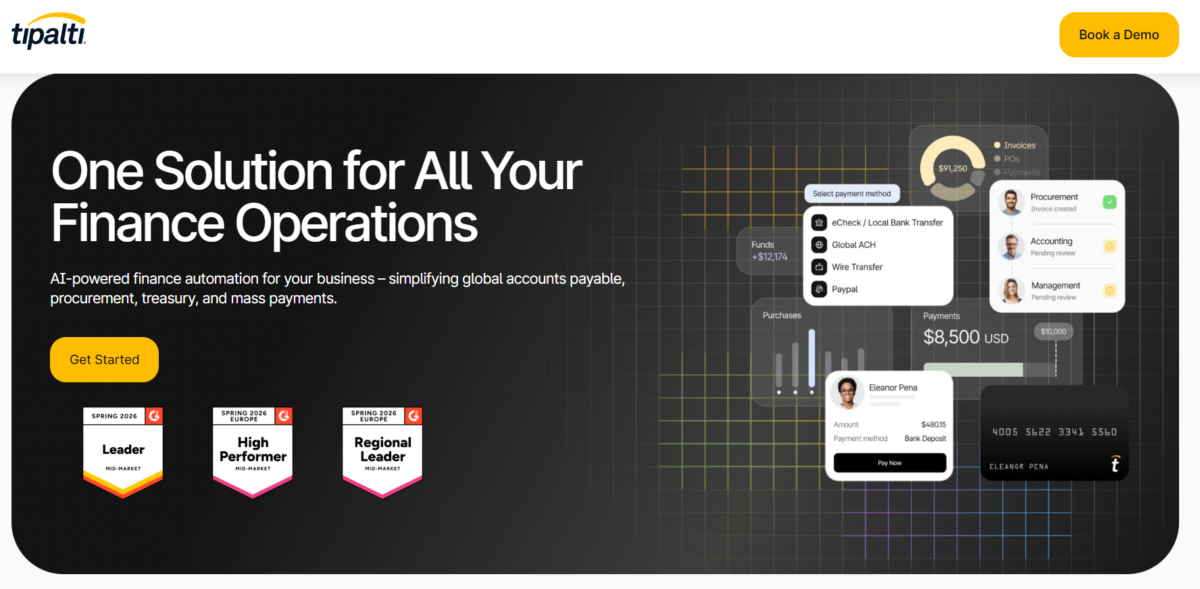
Tipalti is built for businesses that need to manage large volumes of vendor payments without manual work slowing them down. As payout complexity increases, automation becomes essential, and that’s exactly where Tipalti focuses.
The platform handles automated vendor payments by running payouts based on predefined rules and approval workflows. This removes the need for manual processing and reduces operational errors. It also includes strong tax and compliance management. Businesses can collect tax forms, validate vendor data, and stay aligned with regulatory requirements across different regions. This is critical when working with global suppliers.
Global payout capabilities allow companies to send payments across multiple countries and currencies from one system.
In our experience, once payout volumes grow, finance teams quickly outgrow spreadsheets and manual processes. Tipalti solves that by turning payouts into a structured, automated workflow. For companies scaling accounts payable, it provides control, consistency, and efficiency.
10. Rapyd
Best for alternative payment methods and global coverage
Rapyd is designed for businesses that need to support a wide range of payment methods across different markets. It’s particularly useful when expanding into regions where cards are not the dominant payment option.
Its global payment method coverage allows businesses to accept local payment options, e-wallets, and bank-based methods through one platform. This helps reduce friction when entering new markets and improves payment success rates.
The platform is API-based, giving teams flexibility to integrate payments directly into their systems and adapt flows to their business model. It also supports cross-border transactions, making it easier to operate internationally without managing multiple providers. A typical use case is entering a new region and enabling local payment methods immediately, rather than building separate integrations.
For businesses prioritizing reach and flexibility, Rapyd offers a scalable way to handle global payment diversity.
11. PayPal Business
Best for simple B2B online payments
PayPal Business is one of the most widely recognized platforms for handling online payments. For many companies, it’s often the first step into digital B2B payments because of its simplicity and global reach.
Its global adoption is a major advantage. Businesses can send and receive payments internationally without needing complex setup, which makes it easier to work with clients across different regions.
PayPal also offers built-in invoicing tools. Companies can create and send invoices directly from the platform, track payment status, and get paid without additional systems. This works well for smaller teams or businesses with straightforward payment workflows. Online payment acceptance is simple to implement. Payments can be collected via links, checkout pages, or directly through the PayPal interface, reducing the need for technical integration.
It doesn’t offer the same level of customization as API-first platforms, but that’s not its goal, so for businesses looking for a simple, trusted way to handle B2B payments, PayPal Business remains a practical and widely used option.
12. Nickel
Best for transparent cash-flow management for core U.S. businesses

Nickel combines accounts receivable and payable with business cash-management tools, giving teams one place to request and collect payments, pay vendors or contractors, and manage cash flow. It supports domestic and international payments across 135+ countries, including ACH, cards, wires, and paper checks. Native integrations and an inbox-based AI finance assistant can also help teams automate payment follow-ups, bill preparation, and reporting.
Key features to look for in B2B payment platforms
Choosing between b2b payment providers isn’t just about pricing – it’s about how well the platform supports real business workflows. The right infrastructure should simplify operations, not add complexity as your business grows.
Global payment capabilities are essential. Businesses need to send and receive funds across regions without relying on multiple providers. This becomes even more important when dealing with different currencies and local payment methods in international markets.
Payment automation is another key factor. Instead of manually processing invoices and transfers, systems should handle recurring payments, approvals, and reconciliation automatically. This reduces operational overhead and minimizes errors.
Compliance and security also play a major role. b2b payment processors must support KYC, AML, and fraud prevention while keeping transactions efficient and user-friendly.
For international operations, multi-currency support is critical. It allows businesses to hold and manage funds across currencies without constant conversions, helping control costs and improve cash flow.
API integrations define flexibility. With strong API integrations, payments can be embedded directly into internal systems or platforms, enabling automation and better control.
Finally, reporting and reconciliation should be built in, giving finance teams clear visibility and control as transaction volumes increase.
Common challenges in B2B payments
B2B payments often look simple at first, but complexity increases quickly as transaction volume grows. What works for a small number of payments rarely scales without issues.
Cross-border payment complexity is one of the biggest challenges. Different currencies, payment methods, and regional regulations create friction if systems aren’t designed for global operations from the start.
Manual invoicing and reconciliation are another common problem. Many businesses still rely on spreadsheets or disconnected tools, which slow processes and increase the risk of errors. As payment volume increases, this approach becomes difficult to manage.
Payment delays also impact operations. When approvals, transfers, and confirmations aren’t automated, it can disrupt supplier relationships and create uncertainty around cash flow.
Currency conversion adds another layer of difficulty. Without proper systems, businesses deal with inconsistent exchange rates and unclear costs, making financial planning harder.
Compliance and fraud prevention become more demanding as businesses grow. Meeting regulatory requirements while maintaining smooth payment flows requires structured systems.
These challenges are exactly why modern B2B payment platforms exist – to reduce friction, automate processes, and bring control to complex payment workflows.
Modernize your B2B payments infrastructure
B2B payments are no longer just operational – they directly impact how a business scales, manages risk, and supports growth across markets. The right platform doesn’t just move money; it creates structure, consistency, and control over financial operations.
Modern payment systems help automate workflows, manage international transactions, and maintain compliance without constant manual effort. Instead of handling invoices, approvals, and transfers separately, everything can run through one connected system. This improves cash flow visibility, reduces delays, and removes operational bottlenecks.
As companies grow, payment complexity increases quickly. More currencies, more partners, more transactions. Without scalable infrastructure, teams end up relying on manual processes or disconnected tools, which slows down operations and increases the risk of errors.
From our experience, a practical checklist makes the decision easier:
- Identify how payments flow across your business
- Evaluate international payment and currency requirements
- Compare automation and integration capabilities
- Choose infrastructure that scales with transaction volume
The goal isn’t just to process payments – it’s to build a system that supports long-term growth and stability. If you’re evaluating options, explore ConnectPay to see how modern payment infrastructure supports global B2B operations and helps businesses scale efficiently.
FAQs (questions only)
What are B2B payment platforms?
B2B payment platforms are systems that help businesses send, receive, and manage payments between companies. They support invoicing, approvals, cross-border transfers, and compliance requirements. Unlike consumer payment tools, they are built for higher transaction volumes, larger amounts, and more complex workflows involving multiple stakeholders and financial processes.
How do B2B payments work?
B2B payments typically involve invoices, approvals, and scheduled transfers. A business issues an invoice, the finance team approves it, and the payment is processed through a bank transfer, card, or payment platform. Modern systems automate this process, handling execution, reconciliation, and reporting in one workflow.
What payment methods are used in B2B transactions?
Common B2B payment methods include bank transfers (SEPA, ACH, wire), cards, and digital wallets. Some businesses also use automated clearing systems or virtual accounts. The choice depends on transaction size, geography, and how frequently payments are made.
How can enterprises improve local b2b payment efficiency, reduce costs, and
minimize reconciliation errors?
Enterprises improve B2B payment efficiency by automating invoice matching and reconciliation, using local bank rails like SEPA instead of expensive wire transfers, and consolidating payments through a single platform like ConnectPay rather than multiple disconnected systems. ERP integration is key here, since automated matching between payments and invoices is what actually eliminates manual reconciliation errors.
How do B2B payment processors handle international payments?
B2B payment processors handle international payments by supporting multiple currencies, managing FX conversion, and connecting to global payment networks. They automate cross-border transfers and provide visibility into fees, exchange rates, and transaction status.
How do businesses evaluate scalability in b2b payment platforms?
Businesses evaluate B2B payment platform scalability by testing API rate limits and uptime, checking multi-currency and multi-entity support, and confirming the provider can handle growing transaction volume without manual intervention. ConnectPay’s compliance infrastructure scales automatically with volume, which matters since manual compliance review otherwise becomes a bottleneck as transaction counts grow.


