













 17 min read
  Last updated: 30 Sep 2026


When we evaluate modern financial tools, we see that online banking apps have fundamentally redefined how people and companies manage money. An app for online banking allows you to move funds, track expenses, and manage cards entirely from your phone, bypassing the slow, branch-based systems of legacy banks. However, a massive difference exists between personal and business banking platforms. Personal apps focus heavily on consumer budgeting, peer-to-peer transfers, and travel spending. Conversely, a business online banking platform must handle rigorous compliance, multi-currency corporate payments, and scalable financial infrastructure.
In this guide, we break down the best online banking apps available on the market today. We divide these solutions into two distinct categories: everyday apps designed for individual consumers and robust financial platforms like ConnectPay engineered for growing digital businesses.
Quick Answer: What Are the Best Online Banking Apps?
If you are quickly searching to find what are the best online banking apps, here is our summary of the market leaders. Remember, the right choice depends entirely on whether you need a simple consumer tool or a robust corporate platform.
- Revolut: The top consumer choice for digital-first travel and multi-currency spending.
- N26: The cleanest mobile experience for basic European personal banking.
- Monzo: The absolute best consumer app for budgeting and saving pots in the UK.
- Chime: The top no-fee consumer option for users in the United States.
- ConnectPay: The best platform for European online businesses needing full financial infrastructure and compliance.
- Wise Business: The most cost-effective business tool for simple international transfers.
- Mercury: The go-to banking platform for US-based startups and tech founders.
When asking for the best apps for online banking, you must first clarify if you are managing your personal salary or executing complex corporate payouts. We highlight the best ones across both categories below.
Best Online Banking Apps: Comparison
To help you make a fast decision, we built this comparison table summarizing the best online banking apps across both personal and corporate use cases. It highlights the core focus of each online banking provider we have evaluated in this guide.
| Provider | Type | Core Features | Best For | Key Advantage |
|---|---|---|---|---|
| Revolut | Personal | Multi-currency, budgeting, travel cards | Global travelers | Best UX and international spending |
| N26 | Personal | Basic accounts, spending insights | European consumers | Clean, minimalist interface |
| Monzo | Personal | Savings pots, instant notifications | UK consumers | Unmatched budgeting tools |
| Chime | Personal | No fees, early direct deposit | US consumers | Highly accessible, zero-fee banking |
| Starling Bank | Personal | Full banking features, no fees | UK consumers | Full-featured digital current accounts |
| PayPal | Personal | Digital wallet, peer-to-peer transfers | Online shoppers | Instant brand trust & global reach |
| ConnectPay | Business | Multi-currency IBANs, BaaS, SEPA/SWIFT | European platforms | Full financial infrastructure & compliance |
| Wise Business | Business | Global transfers, local account details | International SMBs | Low, transparent FX fees |
| Revolut Business | Business | Multi-currency, team access, cards | Digital agencies | Strong UX and expense management |
| Mercury | Business | API access, treasury tools, integrations | US Startups | Built specifically for tech founders |
| Payoneer | Business | Marketplace integrations, receiving accounts | Freelancers | Global payouts and marketplace connectivity |
| Brex | Business | Corporate cards, banking, AI expense management | Venture-backed startups | High credit limits & spend automation |
| Airwallex | Business | Multi-currency, APIs, global acquiring | Enterprise SaaS | Powerful, scalable global infrastructure |

Ready to upgrade your payment infrastructure?
Stop struggling with fragmented payment flows. Access dedicated IBANs, SEPA Instant, and seamless API integrations – all from a single, unified platform.
Personal Use: Best Online Banking Apps
We will start with consumer applications. These platforms represent the best apps for online banking if your primary goal is managing your daily salary, splitting bills with friends, or avoiding foreign exchange fees while traveling. Personal app for online banking focuses entirely on everyday personal spending and a mobile-first user experience. If you are looking to open personal online banking accounts, these are the market leaders.
Revolut
Best for: Digital-first banking and international spending

We see Revolut acting as the ultimate mobile-first banking app designed for consumers who travel frequently or spend globally. It operates as a comprehensive financial super-app. You can hold and exchange dozens of currencies instantly at highly competitive rates. They offer disposable virtual debit cards for secure online shopping, deep budgeting analytics, and even built-in crypto investment tools. We consider it a powerhouse among the best online banking apps for individuals.
Pros:
- Excellent UX: The app is incredibly intuitive and fast to navigate.
- Travel Mastery: Multi-currency support makes it the absolute best card for international travel.
- Speed: Peer-to-peer payments and bank transfers execute instantly.
Cons:
- Paywalls: They aggressively push tiered pricing; many advanced features require a paid monthly subscription.
- Weekend FX Fees: They apply markups on currency exchange during weekends when markets close.
N26
Best for: Simple and clean mobile banking in Europe

N26 operates as a fully digital European bank built with an intense focus on extreme simplicity. We recommend N26 to users who want a distraction-free online banking experience. The app strips away the clutter found in traditional banking apps. It focuses cleanly on core mobile banking tasks: tracking your spending, categorizing your expenses, and managing a reliable Mastercard.
Pros:
- Clean Interface: It offers one of the most minimalist, intuitive interfaces on the market.
- Easy Setup: You can open an account directly from your phone in under ten minutes.
- No Branches: It is 100% digital, removing the need to ever visit a physical bank location.
Cons:
- Limited Advanced Features: It lacks the deep investment or complex financial tools found in super-apps.
- Market Restrictions: It remains primarily restricted to specific European markets.
Monzo
Best for: Budgeting and everyday money management

Monzo dominates the UK market by focusing intensely on helping consumers manage their money better. We view Monzo as the absolute best consumer tool for budgeting. The app features intelligent “savings pots” that let you partition your money for specific goals (like rent or holidays). It sends instant, satisfying notifications the second you spend money, giving you total financial visibility and tight control over your daily habits. It stands out clearly among the best apps for online banking.
Pros:
- Strong Budgeting: The automated categorization and saving pots are unmatched.
- User-Friendly: The app feels friendly, accessible, and highly responsive.
- Visibility: Instant push notifications keep you acutely aware of your balances.
Cons:
- UK Focus: Availability and core features are heavily restricted outside the UK.
- Limited Global Use: It is less powerful than Revolut for heavy international travel.
Chime
Best for: No-fee mobile banking in the US

Chime operates as a US-focused app for online banking that completely eliminates traditional banking fees. We see Chime as the top choice for users frustrated by the maintenance fees of legacy American banks. They charge zero monthly fees, zero overdraft fees, and zero minimum balance fees. Their standout feature allows users to access their direct deposit paychecks up to two days early.
Pros:
- Zero Fees: They eliminate the punishing monthly maintenance fees common in US banking.
- Early Access: Getting paid two days early provides massive cash flow relief for consumers.
- Simple Setup: The account opening process is highly accessible.
Cons:
- US Only: The platform is entirely restricted to United States residents.
- Basic Tools: It offers very limited advanced financial tools compared to European fintechs.
Starling Bank
Best for: Full-featured mobile banking in the UK

Starling Bank operates as a fully licensed digital bank in the UK, offering the complete feature set of a traditional bank but delivered entirely via a world-class mobile app. We see Starling bridging the gap for users who want modern online banking tech but demand the stability of a traditional current account. They offer joint accounts, robust savings features, and highly capable business accounts all within one ecosystem.
Pros:
- No Monthly Fees: They offer full banking functionality without punishing monthly charges.
- Strong Functionality: The app is incredibly stable and feature-rich.
- Full Banking: They offer overdrafts and loans just like a traditional high-street bank.
Cons:
- UK Focused: Their services remain heavily concentrated on the UK market.
- Limited Global Reach: They lack the aggressive cross-border focus of some competitors.
PayPal
Best for: Easy online payments and global transfers
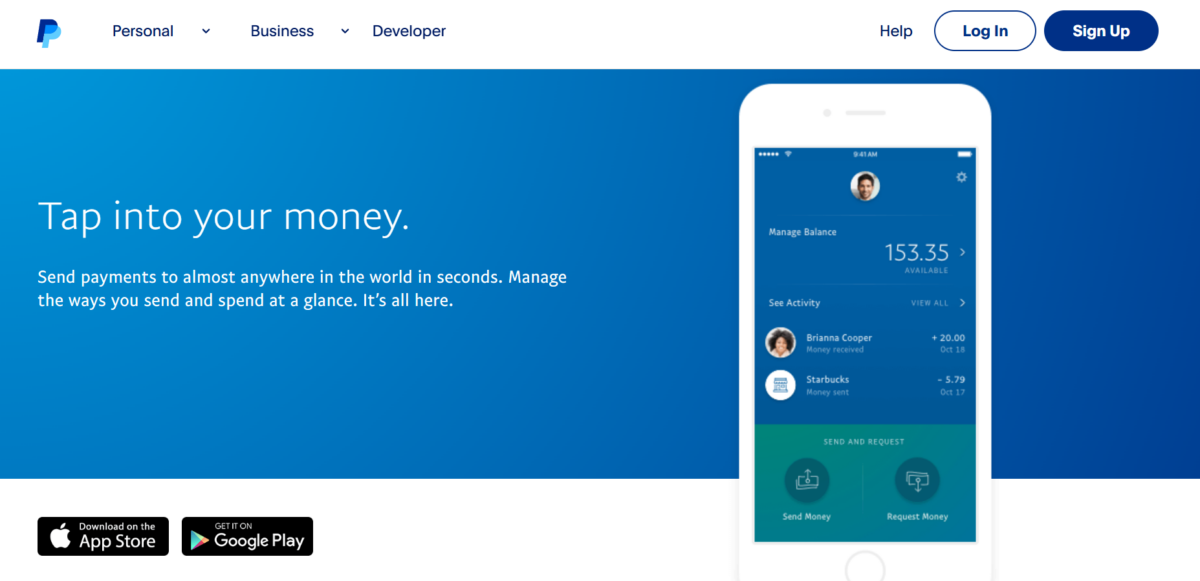
We include PayPal here because it acts as a digital wallet that many consumers use essentially as an online banking tool. While not a full bank, it dominates peer-to-peer payments and online checkout. You can link your cards, hold balances, and send global transfers instantly. It remains one of the best digital wallets for general consumer convenience and widespread acceptance. It is undeniably one of the best online banking apps for simple internet commerce.
Pros:
- Widely Accepted: Almost every online merchant globally accepts PayPal.
- Easy to Use: Splitting a bill or sending money to a friend takes seconds.
- Fast Transfers: Payments between PayPal users execute instantly.
Cons:
- High FX Costs: Their currency conversion fees are notoriously high and opaque.
- Not a Bank: It lacks traditional banking features like dedicated IBANs or deep budgeting tools.
Business Use: Best Online Banking Apps
When managing a company, a consumer app will fail you. Businesses need significantly more than basic banking. You require deep compliance infrastructure, multi-currency accounts, scalable APIs, and accounting integrations. We evaluated the market to find the best online banking apps specifically engineered for corporate operations. These are the tools that handle true business online banking efficiently. If you need robust online business banking accounts, look closely at these platforms.
ConnectPay
Best for: European online businesses needing full financial infrastructure

We built ConnectPay as a fully EMI-licensed online banking platform specifically designed for the complex needs of European digital businesses. We see growing platforms struggle when they outgrow basic business apps. We offer a platform that goes far beyond simple banking.
Our core features include dedicated multi-currency IBANs, seamless SEPA and SWIFT routing, and a complete Banking-as-a-Service (BaaS) infrastructure. Furthermore, we handle the heavy lifting of compliance. We enforce strict GDPR and PSD2 adherence, manage complex KYC/AML onboarding, and maintain top-tier ISO certifications. Through the ConnectPay online banking app, business owners manage multi-currency payments securely using Apple Pay and biometric authentication. We position ConnectPay as a full financial infrastructure, not just a banking app. It is one of the very best online banking apps for serious corporate scale.
Pros:
- Multi-currency Power: We offer massive cross-border capabilities to handle international revenue seamlessly.
- Built-in Compliance: We protect your business by managing the strictest European security and regulatory standards.
- Scalable Infrastructure: Our BaaS and API tools allow your platform to grow without switching providers.
Cons:
- Advanced Features: The platform is engineered for more complex businesses; it may be overkill for a sole proprietor running a local cash business.
Wise Business
Best for: Small businesses handling international payments

Wise Business operates as a powerful multi-currency business account. We recommend Wise Business specifically for SMBs that frequently pay international suppliers or receive foreign revenue. They provide local account details (like a US routing number or a UK sort code) to businesses globally. Their biggest strength is their absolute transparency regarding foreign exchange fees, always using the mid-market rate. It is a highly efficient online banking tool for cross-border SMBs.
Pros:
- Transparent Fees: Their FX costs are incredibly low and clearly stated upfront.
- Easy to Use: The interface for sending international wires is fast and intuitive.
- Global Coverage: They allow you to hold and convert dozens of currencies easily.
Cons:
- Limited Infrastructure: They lack the deep embedded finance or BaaS tools of more advanced platforms.
- Not for Complex Models: It struggles to support complex marketplace payout structures.
Revolut Business
Best for: Digital-first businesses in Europe

Revolut Business takes the excellent UX of their consumer app and applies it to corporate banking. We see digital agencies and modern SMBs adopt Revolut Business for its clean, app-based approach. It offers strong multi-currency accounts, allows you to issue corporate cards to your team easily, and integrates smoothly with accounting software like Xero and Slack. It ranks highly among the best apps for online banking for modern European teams.
Pros:
- Strong UX: The mobile and web interfaces are modern and highly responsive.
- Team Access: It makes managing employee expenses and corporate cards very simple.
- Flexible Plans: You can scale up your monthly subscription as your team grows.
Cons:
- Tiered Pricing: Core features quickly get locked behind expensive monthly paywalls.
- Compliance Tools: It offers less customized compliance infrastructure compared to specialized EMI platforms.
Mercury
Best for: Startups and tech companies

Mercury operates as a digital banking platform built specifically from the ground up for tech startups. We see US-based founders flock to Mercury because it integrates flawlessly into the tech ecosystem. They offer excellent API access, clean integrations with payroll providers, and advanced treasury tools to help well-funded startups manage their venture capital cash efficiently. It is undeniably one of the best online banking apps for the Silicon Valley ecosystem.
Pros:
- Excellent Integrations: It connects perfectly with the tools modern tech companies actually use.
- Clean Interface: The dashboard is beautifully designed for finance teams.
- Startup Focus: They offer specific tools like venture debt and treasury management.
Cons:
- US Focused: Their services are heavily restricted to US-registered corporate entities.
- Limited International: They lack the deep cross-border infrastructure of European EMI providers.
Payoneer
Best for: Freelancers and global sellers
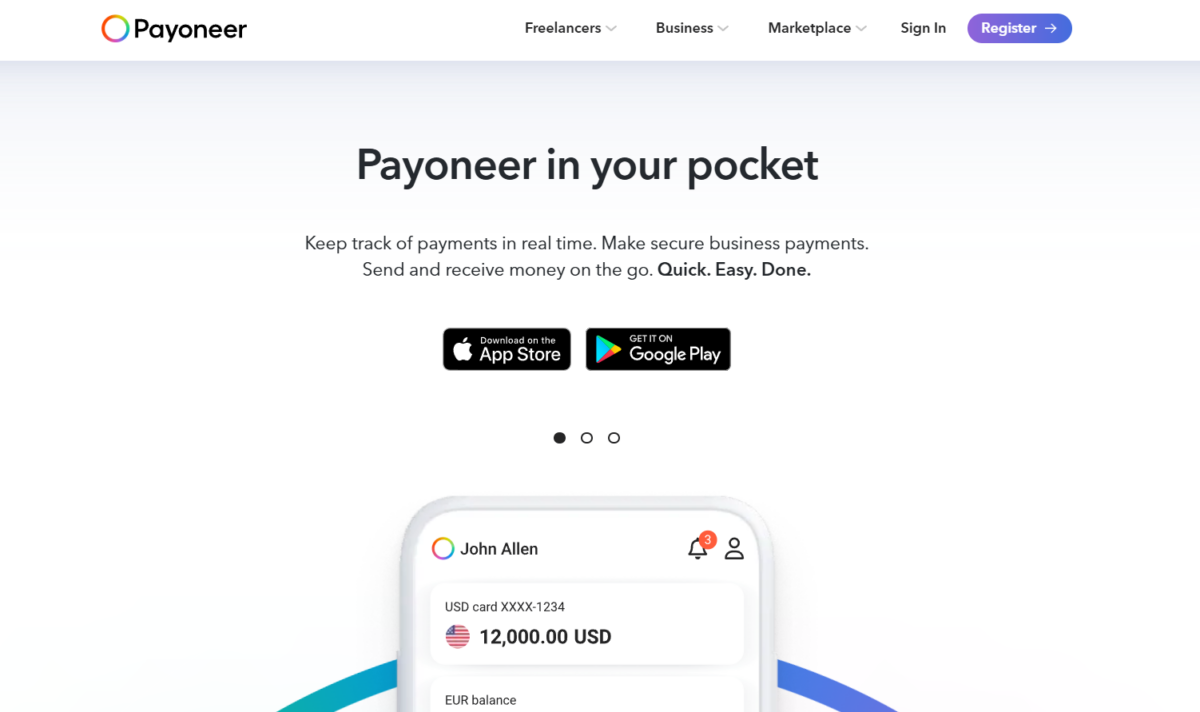
Payoneer focuses intensely on cross-border payments for freelancers, Amazon sellers, and independent contractors. We see Payoneer acting as a crucial receiving account for independent global workers. It integrates deeply with massive global marketplaces, allowing sellers in emerging markets to receive USD or EUR payouts easily and then withdraw funds to their local bank accounts. For independent global workers, it is a vital online banking tool.
Pros:
- International Presence: It serves users in emerging markets that other platforms ignore.
- Marketplace Integrations: It connects directly to platforms like Amazon, Upwork, and Fiverr.
- Receiving Global Payments: It makes getting paid by international clients very easy.
Cons:
- Accumulating Fees: Their withdrawal and transfer fees can add up significantly over time.
- Less Flexible: It acts more as a payout receiving tool than a full corporate banking platform.
Brex
Best for: Scalable financial operations and global spend management

We see Brex providing a comprehensive financial stack that combines corporate cards, banking, and AI-powered expense management into a single unified platform. Designed to help companies scale from seed stage to global enterprise, Brex offers up to 30x higher credit limits than traditional banks and significantly reduces manual accounting work through intelligent automation. With support for operations in over 120 countries and competitive yields on business cash, it stands out as a high-performance financial foundation for modern businesses.
Pros:
- High Spending Power: Provides substantially higher credit limits by evaluating a company’s cash balance and backing.
- Deep Automation: AI-driven tools handle receipt matching and expense categorization, saving finance teams hundreds of hours.
- Global Infrastructure: Built-in support for global travel, local currency cards, and international payments across 120+ countries.
Cons:
- Selective Acceptance: Typically requires significant cash reserves or venture funding to qualify for the full suite of services.
- Business Only: The platform is exclusively designed for corporate use and does not offer personal banking features.
Airwallex
Best for: Global businesses and SaaS platforms
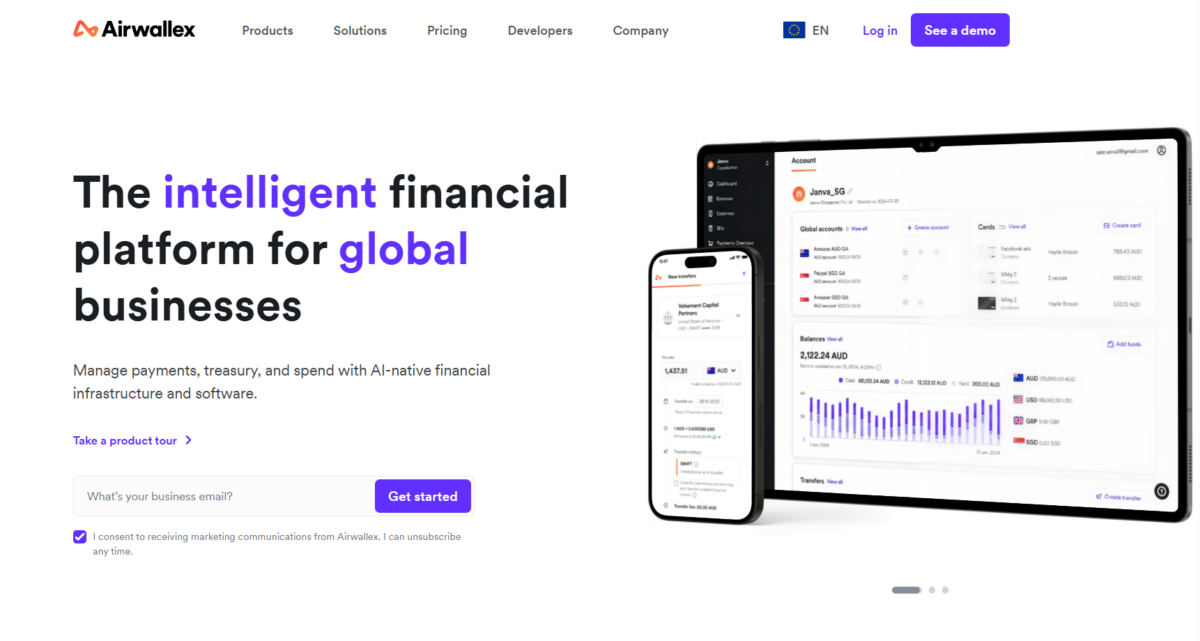
Airwallex operates as a massive financial infrastructure platform offering robust banking features. We see large global businesses and SaaS platforms use Airwallex to programmatically manage international cash flows. They offer powerful multi-currency accounts, highly capable APIs, and the ability to issue corporate cards globally. It is built for serious scale and stands as one of the best online banking apps for massive international operations.
Pros:
- Strong APIs: Their technical documentation allows for deep, programmatic financial control.
- Global Coverage: They offer excellent global acquiring and payout networks.
- Scalable Platform: It handles massive enterprise transaction volumes easily.
Cons:
- Complex Setup: The integration and onboarding process requires significant technical effort.
- Target Audience: It is generally too complex and expensive for simple SMBs or local retail stores.
Personal vs Business Online Banking Apps: Key Differences
You must understand the distinct operational differences between these two categories. Personal online banking apps prioritize consumer UX, gamified saving tools, and simple peer-to-peer transfers. They are designed for an individual managing a salary.
Business platforms, however, must handle entirely different risk profiles. The best online banking apps for business focus heavily on multi-user access controls, accounting integrations, and bulk payment execution. More importantly, corporate platforms must navigate incredibly complex compliance landscapes. While a consumer app just checks an ID, a business platform like ConnectPay must verify complex corporate ownership structures (KYB) and monitor massive B2B transaction flows for AML compliance. Furthermore, advanced business platforms offer embedded finance and banking as a service tools, allowing digital platforms to actually issue accounts and cards to their own users—a feature consumer apps simply do not possess.
Key Features to Look for in an Online Banking App
When you evaluate the best apps for online banking, do not just look at the marketing website. You must evaluate how the software handles the mechanics of daily banking. We recommend focusing on these four critical operational pillars.
Mobile Experience and Usability
If the app crashes or hides important features behind confusing menus, it fails its primary purpose. The best apps offer biometric login (FaceID), instant push notifications for every transaction, and clear, exportable statements. You should be able to freeze a lost card or execute a transfer in under three taps.
Payments and Transfers
Evaluate how the app moves money. Does it support instant SEPA transfers in Europe? Can a business app execute bulk payment solutions to pay 100 suppliers simultaneously with one click? The app must support the specific payment rails your daily life or business operations demand.
Security and Authentication
Security cannot be an afterthought. The app must mandate Two-Factor Authentication (2FA) for all significant actions. Look for features like dynamic CVV codes for online shopping, location-based security flagging, and the ability to instantly lock specific types of transactions (like disabling ATM withdrawals while traveling).
International Capabilities
If you travel personally or sell globally as a business, you need an app that handles cross-border payments seamlessly. Look for apps that offer transparent foreign exchange rates without hidden weekend markups, and the ability to hold dedicated balances in multiple currencies simultaneously to avoid constant conversion fees.
Ready to Upgrade Your Banking Experience?
The days of tolerating slow, expensive, and clunky legacy bank portals are over. Whether you are an individual tracking your daily expenses or a founder managing complex international payroll, upgrading to one of the best online banking apps will save you massive amounts of time and capital.
For individual consumers, switching to a digital-first mobile app provides instant clarity and control over your personal finances. For growing digital businesses, however, the stakes are much higher. You cannot afford to run a scaling marketplace on a basic consumer tool. You need a dedicated partner that provides true financial infrastructure. We built ConnectPay specifically to offer European online businesses the multi-currency capabilities, robust APIs, and ironclad compliance they need to scale securely globally. If your business has outgrown simple banking apps and requires a serious financial infrastructure upgrade, it is time to explore a more powerful solution.
FAQs: Best Online Banking Apps
What are the best online banking apps?
For personal use, Revolut and Monzo lead the market in UX and features. For business use, ConnectPay is top-tier for European platforms needing compliance and BaaS, while Mercury dominates for US tech startups.
Are online banking apps safe?
Yes. Licensed digital banks and EMIs (like ConnectPay) utilize the same strict encryption, biometric security, and regulatory compliance protocols (like PSD2 and GDPR) as traditional legacy banks.
Which banking app is best for business?
It depends on your model. Wise is great for simple international SMB payments. Revolut Business offers a great interface for modern agencies. ConnectPay is the absolute best for digital platforms and marketplaces needing scalable multi-currency infrastructure and embedded finance tools.
Can I open a bank account fully online?
Yes. All the providers listed in this guide allow you to complete the entire KYC (Know Your Customer) or KYB (Know Your Business) onboarding process digitally via their mobile app or web portal without ever visiting a branch.
What features should a banking app have?
A strong app must feature instant transaction notifications, biometric login security, easy card freezing, seamless international transfer capabilities, and clear, exportable transaction statements for accounting.
Which private banks offer the best digital tools and online access for
clients?
For business clients, ConnectPay and Mercury are known for particularly strong digital-first account management. Among consumer-adjacent digital platforms, Revolut and N26 offer strong digital tools too, though traditional private banks like UBS and J.P. Morgan Private Bank have also upgraded their digital portals in recent years.


